


The Nasdaq 100 lost 5.6% on Friday, November 20, and 10.4% over the week, its worst week since the pandemic crash of March 2020, as investors dumped the chip and AI stocks that had carried the market for two years. Nvidia alone fell 14% in a day. By the close, both the S&P 500 and the Dow Jones had slipped into a correction, meaning a fall of 10% or more from their records, according to Bloomberg’s markets wrap and investingLive.
The irony is hard to miss. The same week brought the biggest stock market debut in history, Anthropic’s $1.3 trillion listing, and that did nothing to stop the slide. Below is what fell, by how much, and the reasons traders gave.
The numbers from Friday and the week
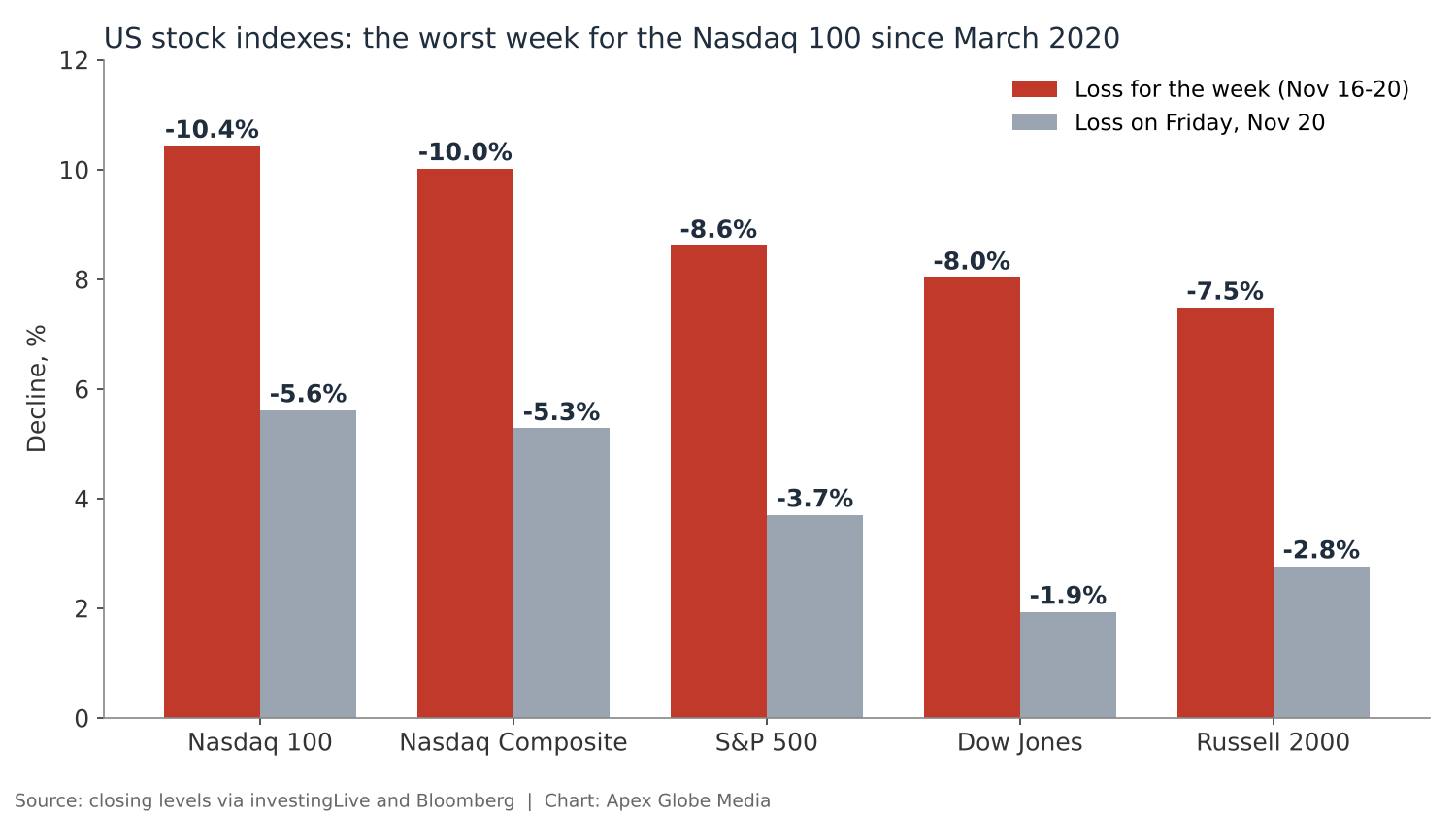
The Nasdaq 100 closed at 25,028.98, down 1,488 points on the day. The broader Nasdaq Composite fell 5.28% to 22,617.73, wiping out all of its gains for 2026. The S&P 500 lost 3.7% to 6,910.39, its seventh straight daily decline, and the Dow fell 1.9%, or about 950 points, to roughly 48,150. For the week, the Nasdaq 100 was down 10.4%, the Composite 10.0%, the S&P 500 8.6% and the Dow 8.0%. investingLive says it was also the Dow’s worst week since March 2020.
Yahoo Finance estimates the S&P 500 lost about $2.4 trillion in market value on Friday alone, and about $8 trillion since its October 6 record, nearly $6 trillion of it this week. The Nasdaq 100 ended just short of a bear market, the usual name for a 20% drop from the peak. The VIX, Wall Street’s “fear gauge”, rose about 26% to near 36, its highest level since April 2025.
Chips took the worst of it
This was not a broad panic so much as a stampede out of one trade. Bloomberg says its gauge of chipmakers sank 11% on Friday. Yahoo Finance reports the PHLX Semiconductor Index fell about 17% in the week and is down by a third since September 30, its worst two months since late 2008.
Friday’s losses, according to investingLive’s closing data:
- Nvidia fell 14.01% to $125.53. Yahoo Finance says the company has lost about $2.7 trillion in value since its October top.
- Arm fell 14.1%, Micron 13.9%, AMD 13.3% and Broadcom 12.2%.
- AI cloud providers dropped too: Nebius lost 16.1% and CoreWeave 12.0%.
- Memory and networking names such as SanDisk (-16.1%), Credo (-15.2%), Lumentum (-13.9%) and Arista (-11.6%) were also hit hard.
- Chip equipment makers Applied Materials, KLA and Lam Research each lost more than 10%.
Big platform companies fell less: Amazon lost about 4.1% and Meta about 5.9%. Consumer staples and healthcare stocks rose, a typical sign of money moving to safer corners of the market rather than leaving it entirely.
Why it happened
Traders pointed to several problems landing in the same week.
Doubts about the AI build-out. The main theme in Bloomberg’s wrap is the fear that spending on AI data centers “is running out of steam”. Richard Saperstein of Treasury Partners called the move an “AI repricing”. Steve Sosnick of Interactive Brokers summed up Friday in one word: “Smackdown!” He said the trouble stems from investors’ rapidly changing views on technology.
Nvidia’s own crisis. The company has been without its founder since Jensen Huang resigned as CEO on November 12 after a board investigation. On Friday Bloomberg and investingLive cited a Reuters report that US regulators are investigating Nvidia’s accounting practices. The Wall Street Journal had reported on November 17 that the SEC opened a civil investigation into whether the company’s disclosures misled investors, according to PYMNTS. Part of the scrutiny concerns revenue Nvidia booked through Singapore, which it stopped reporting separately after 2025. Nvidia has said that Singapore revenue “does not indicate diversion to China”. According to Yahoo Finance, Nvidia’s first quarterly report since Huang’s exit showed revenue more than doubling, and the stock still fell.
Interest rates. Bond traders have been betting that the Federal Reserve might raise rates again in December to fight inflation, which makes expensive growth stocks less attractive. On Friday they stopped fully pricing a quarter-point hike, Bloomberg says, and the 10-year Treasury yield fell about 11 basis points to 4.93%, a flight to safety rather than relief.
Anthropic’s debut did not lift the mood. Anthropic, whose IPO raised a record $81.3 billion at $83 a share, opened at $111.50 on Thursday and closed its first day up 17%. On Friday it fell 8.5% to $88.91. It is still above its IPO price, but the drop showed that even the hottest AI name could not reverse the trend.
Policy noise added to the pressure. Reuters reported on Friday that President Trump said the US would penalise companies that build data centers abroad, which raises fresh questions for the cloud giants’ global expansion plans.
Crypto and gold fell too
Usually some assets rise when stocks crash. This time almost everything risky went down together. Bitcoin dropped about 5% to around $58,000, according to Bloomberg, and other reports put its low near $57,000, the lowest in more than two years and less than half of its October 2025 peak above $126,000. Ether lost about 8% to roughly $1,600. Even gold, the classic safe haven, fell 2.8% to about $3,523 an ounce, as investors sold what they could to cover losses elsewhere.
Correction or the start of something worse?
Strategists quoted by Bloomberg were split. Chris Larkin of E*Trade from Morgan Stanley noted that only five of the past 15 corrections from all-time highs since 1983 turned into bear markets. Mark Hackett of Nationwide said “a capitulatory washout could ultimately prove constructive”, meaning a final wave of panic selling often clears the way for a recovery. Neil Dutta of Renaissance Macro Research was more cautious: if the market prices out further Fed moves for bad reasons, he said, he would not see it as a welcome development.
Yahoo Finance points out a detail that cuts both ways. About half of S&P 500 stocks are still above their 50-day average, and the equal-weight version of the index is roughly flat since September 30. Jim Bianco noted that an S&P 500 version excluding AI stocks is only about 5% below its record. In other words, most of the damage is concentrated in the AI trade itself. That is reassuring for the wider economy, but it also means the market leaders that pushed indexes to records are the ones now in trouble. Jonathan Krinsky of BTIG said it “would be unprecedented” for the market to put in a final low while half of the S&P 500 is still above that average, which suggests more selling may come before a bottom.
We wrote earlier this month about the first cracks in AI stocks after the midterm elections. Two weeks later, those cracks have become the biggest weekly loss in more than six years.
Our take
The week’s mix of a record AI IPO and a record-setting chip sell-off is less contradictory than it looks. Investors are not saying AI has no future; they are questioning whether the companies selling the picks and shovels, above all Nvidia, can keep growing at the pace their prices assumed, especially with Nvidia now leaderless and under regulatory scrutiny. The fact that stocks outside AI are holding up suggests this is a repricing of one crowded trade, not the start of a recession scare. But when a single company can lose $2.7 trillion in seven weeks, the market’s dependence on a handful of AI names has become a risk in its own right, and the next weeks of data center spending news will matter more than any IPO.