

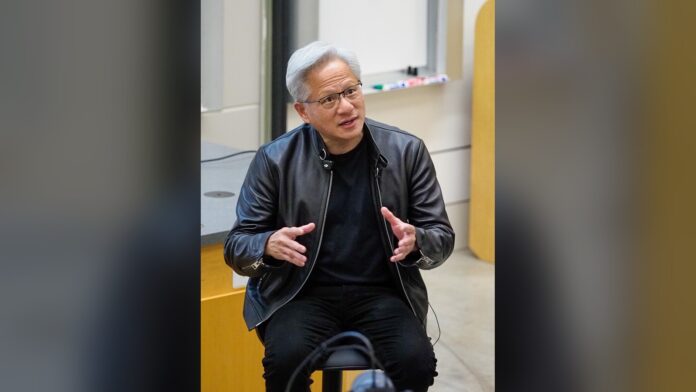

Eleven days after he resigned in a scandal that tied him to a suspected Chinese spy, Nvidia’s founder is back. With Jensen Huang reinstated as president and chief executive, and as a member of the board, its board has made a sharp U-turn. The board voted unanimously on Monday, November 23, and said in its announcement filed with the SEC that it had “received input from senior levels of the United States government” and, based on that input, was “confident that Mr. Huang’s reinstatement poses no national security risk.” Nvidia shares rose more than 30% before the market opened, and Yahoo Finance showed the stock at $165.49, up 31.8%, shortly after the opening bell.
Only last week, the new board chair, Harvey Jones, told investors on Nvidia’s earnings call that the board had accepted Huang’s resignation and did not intend to bring him back, The Hill reported. What changed in between was not new evidence about Huang. It was the position of the White House.
What the board actually said
The statement is short and carefully worded. The directors say they reinstated Huang “following a series of discussions and meetings” with him, after which they were “satisfied with respect to Mr. Huang’s candor and ability to lead NVIDIA.” Jones called Huang “the right person to lead NVIDIA” and thanked chief financial officer Colette Kress, who had run the company as interim CEO while keeping her finance job. Jones stays on as chair, so Huang returns to the board as a director, not as its head.
Huang’s own statement said he was “honored to return” and taking the job back “with the greatest humility and renewed commitment.” He thanked the board, Kress, employees and shareholders, and added: “Above all, I am grateful for the love and support of my family. I can’t wait to get back to work.”
Three parts of the filing matter more than the quotes. First, the independent committee that is investigating whether Huang was the target of a foreign intelligence effort “will proceed to conclusion,” and Huang says he will cooperate. Second, the board has set up a new National Security and Export Control Committee of independent directors to oversee trade compliance. Third, Nvidia is creating a chief compliance officer post that will report to the board, not to the CEO. In other words, the board brought Huang back before its own investigation into him is finished, and is building new controls around him at the same time.
How Huang lost the job in the first place
The crisis began with a New York Times report that Huang had a relationship with Alice Huang, an executive at Megaspeed, a Singapore data center company that has bought about $4.8 billion of Nvidia chips and is under investigation over possible diversion of US chips to China. US intelligence suspects her of working for Beijing. We covered who Alice Huang is and what US officials say about her when the story broke. Huang admitted an extramarital affair, and the Times then reported on November 11 that he had also had a relationship with an executive who reported to him, according to CNN. He resigned on November 12.
The departure hit far beyond Nvidia. The company sells the chips that most of the AI industry runs on, and investors treated Huang’s exit as a threat to the whole AI trade. Nvidia fell 14% in a week, and the Nasdaq 100 had its worst week since March 2020. A public petition to bring Huang back, signed by Elon Musk among others, passed 200,000 signatures, CNN said.
Washington changed its mind in a week
The more striking turn came from the government. A week ago, Treasury Secretary Scott Bessent was urging an Nvidia shake-up and asking the company to look outside for a new leader. On Sunday, according to The New York Times, he said Huang’s return should depend on the investigations into Nvidia’s chip sales to China. The same day, asked on “Face the Nation” whether Huang could come back, he only said: “Jensen is on the outside now.” Days earlier, President Trump had floated former Apple CEO Tim Cook as a possible replacement, Yahoo Finance noted.
Then, on Sunday, Trump wrote on Truth Social: “I hope the Board of Nvidia rehires Jensen Huang. It would be the best thing for the Company, and also, for the U.S.A.” After the announcement on Monday he followed up: “The NVIDIA Board of Directors has made the correct and proper decision to return Jensen Huang to the position of CEO. The Country needs Jensen’s leadership at NVIDIA in order to ensure the Success and Prosperity of not only the Company, but the American Economy.” He added that the attorney general “does not possess evidence that he has engaged in any unlawful conduct.” Minutes before the news, Trump told PBS that Huang was “back where he should be,” which suggests he knew in advance.
Before Monday, traders on the prediction market Kalshi gave Huang only a 16% chance of returning, according to Yahoo Finance. The search for an outsider had also gone some way: Bloomberg reported on Monday that a recruiting firm had approached Arm CEO Rene Haas about the Nvidia job. Haas has instead extended his Arm contract to 2033.
The questions that have not gone away
Not everyone in Washington accepts the “no risk” verdict. Republican Senator John Cornyn replied on X: “No national security risk? Based on what?” A bipartisan group of lawmakers wants to know whether Huang, knowingly or not, helped China get Nvidia’s most advanced chips despite US export controls. He is due to testify at a closed House hearing on December 1, with a transcript to be released later, and has agreed to appear before the Senate at a date not yet set, CNN reported.
Other inquiries are still open. The Justice Department has its own investigation, and TechCrunch, citing The Wall Street Journal, reported last week that the SEC is examining whether Nvidia’s disclosures misled investors. Over the weekend the Times reported that Alice Huang was in contact with an officer of China’s Ministry of State Security from spring 2025 until this autumn. Trump declined to comment on that report.
There is also an uncomfortable political background. The Washington Post reported on Monday that Huang had built a close relationship with Trump and made lobbying calls to win approval for AI chip sales to China, which he called a $50 billion a year market. CNN noted that Trump’s own financial disclosures put his Nvidia holdings at between $12.5 million and $58 million at a $157 share price. The White House says his portfolio is run by third-party institutions and that he has no influence over trades.
Who made money on the round trip?
The speed of the reversal has led many investors to ask whether the crash and the rebound were engineered. Economist Peter Schiff wrote on X: “I think Trump insiders bought $NVDA and other AI-related names near Friday’s close knowing this post would hit before Monday’s open.” He offered no evidence, and none has been reported so far, Cryptopolitan noted. But the questions are reasonable. Trump publicly called for Huang’s return on Sunday night, before markets opened; he appeared to know the decision in advance; and he owns Nvidia shares himself. Prediction markets, by contrast, gave Huang only an 11% to 16% chance of coming back until the news broke, Yahoo Finance reported.
Huang himself is among the biggest winners of the day. Forbes estimated that his fortune rose by about $34 billion on Monday, to roughly $144 billion, almost all of it from his 3.5% stake in Nvidia, FinanceFeeds reported. That gain, though, largely makes up for what he lost during the scandal.
There are strong arguments against a planned operation too. The scandal began with New York Times reporting and US intelligence concerns, Huang admitted the affairs himself, and Nvidia lost about $1.2 trillion in market value during the crisis. Even after Monday’s jump, the stock is still below the roughly $205 it traded at before the story broke, Tom’s Hardware data show. The simple way to settle it is for the SEC to examine who bought Nvidia shares and options in the days before the announcement.
Our take
In our view, this whole episode looks less like a governance crisis than a piece of theatre. A founder is pushed out, the stock and the whole AI market tumble, the President calls for his return on a Sunday night, and on Monday morning the board brings him back citing “senior levels of the US government,” with the shares up 30%. We cannot prove that anyone planned it this way or traded on it, and no one has presented evidence of it. But when the President can move a $4 trillion company’s stock with one post, and holds that stock himself, regulators should check the trading records rather than take anyone’s word for it. As for governance, the board did not wait for its own investigation and did not publish what the government told it. Until the investigations finish and the December 1 testimony is public, Nvidia has swapped one uncertainty for another, and the new compliance committee will have to prove it is more than a fig leaf.