

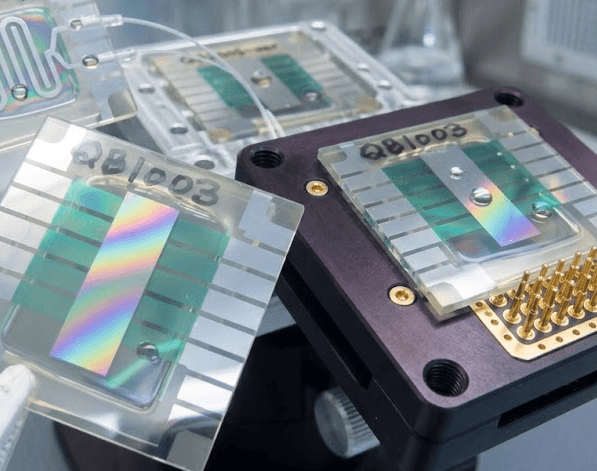

A quantum battery prototype built by Australia’s national science agency, CSIRO, does something no ordinary battery can: the bigger it gets, the faster it charges. In its latest version, published in the journal Light: Science & Applications, the team also managed to draw an electrical current out of the device for the first time. It is a genuine physics milestone. It is also a long way from anything that could power a phone or a car, and the distance between the two is the real story.
Why ordinary batteries slow down as they grow
A lithium-ion battery stores energy in chemical reactions. Each cell charges more or less independently, so a battery with twice the capacity needs roughly twice the energy pushed through the same kind of chemistry, and charging a laptop or an electric car takes from minutes to hours. Fast-charging tricks can speed that up, but heat and wear set hard limits.
A quantum battery stores energy in quantum states of molecules or atoms instead of chemical bonds. The idea, explored by theorists for more than a decade, is that quantum effects could let many storage units absorb energy together rather than one by one.
What CSIRO built
The team, led by quantum scientist James Quach, uses an organic microcavity: a stack of thin layers that traps light between two mirrors, with dye molecules in between. When a laser shines on it, the molecules absorb energy collectively, an effect called superabsorption. Quach explained the scaling in a CSIRO article in March: if N storage units would each take one second to charge alone, together they take about 1/√N seconds each. Doubling the size of the battery cuts the charging time to a little more than half. The team first confirmed that effect experimentally in 2022, with collaborators in the UK and Italy.
The new step is extraction. The latest prototype adds layers that turn the stored energy into an electrical current, which Quach called “a major step towards a practical quantum battery.” Work on the project also involved the University of Melbourne and RMIT University, according to Electronics Online. Unlike competing designs based on superconducting circuits, which have to be cooled close to absolute zero, the CSIRO device works at room temperature, which Quach highlighted as a key advantage.
The catch: tiny and fleeting
The numbers show how early this is. The prototype holds a few billion electron-volts of energy, a minuscule amount, and keeps its charge for only a few nanoseconds, billionths of a second, CSIRO said. A phone battery stores many trillions of times more energy and holds it for weeks. Quach was direct about it: fully functioning quantum batteries do not exist yet.
The underlying problem is decoherence. Quantum states are fragile, and interactions with heat, light and vibrations from the surrounding environment cause them to break down, so the stored energy leaks away. Every quantum technology, from computers to sensors, fights the same battle.
Where it could be used first
The CSIRO team’s next steps are to scale up the prototype, make it hold charge for longer, and develop a hybrid design that combines fast quantum charging with the longer storage of conventional batteries. The most realistic early market is not consumer electronics but quantum computing. Quantum computers need precise, low-noise energy delivery, and the authors suggest quantum batteries could help them scale up.
Other suggested uses, such as charging moving vehicles with lasers, are much further off. For now, the more relevant battery news for phones and cars remains incremental gains in chemistry, along with the AI features that are making devices hungrier for power, a trend we looked at separately.
What it means for business and investors
Quantum batteries are research, not a product category, and companies that claim otherwise should be treated with caution. For investors, the useful signal is where public research money is going: national labs such as CSIRO are treating quantum energy storage as a long-term bet alongside quantum computing and sensing, and CSIRO says it is now looking for development partners, Electronics Online reported. For battery makers and carmakers, the technology does not change any plans for this decade. Its value, if it arrives, will first show up in specialised hardware where speed and precision matter more than capacity.
Our take
CSIRO’s result is solid science: it confirms a counterintuitive quantum effect and, for the first time, gets usable current out of the device. But a battery that holds a few billion electron-volts for a few nanoseconds is a proof of principle, not a prototype for consumer products. The realistic path runs through hybrid designs and quantum computers, over years. Headlines promising instant-charging phones are getting well ahead of the physics.