




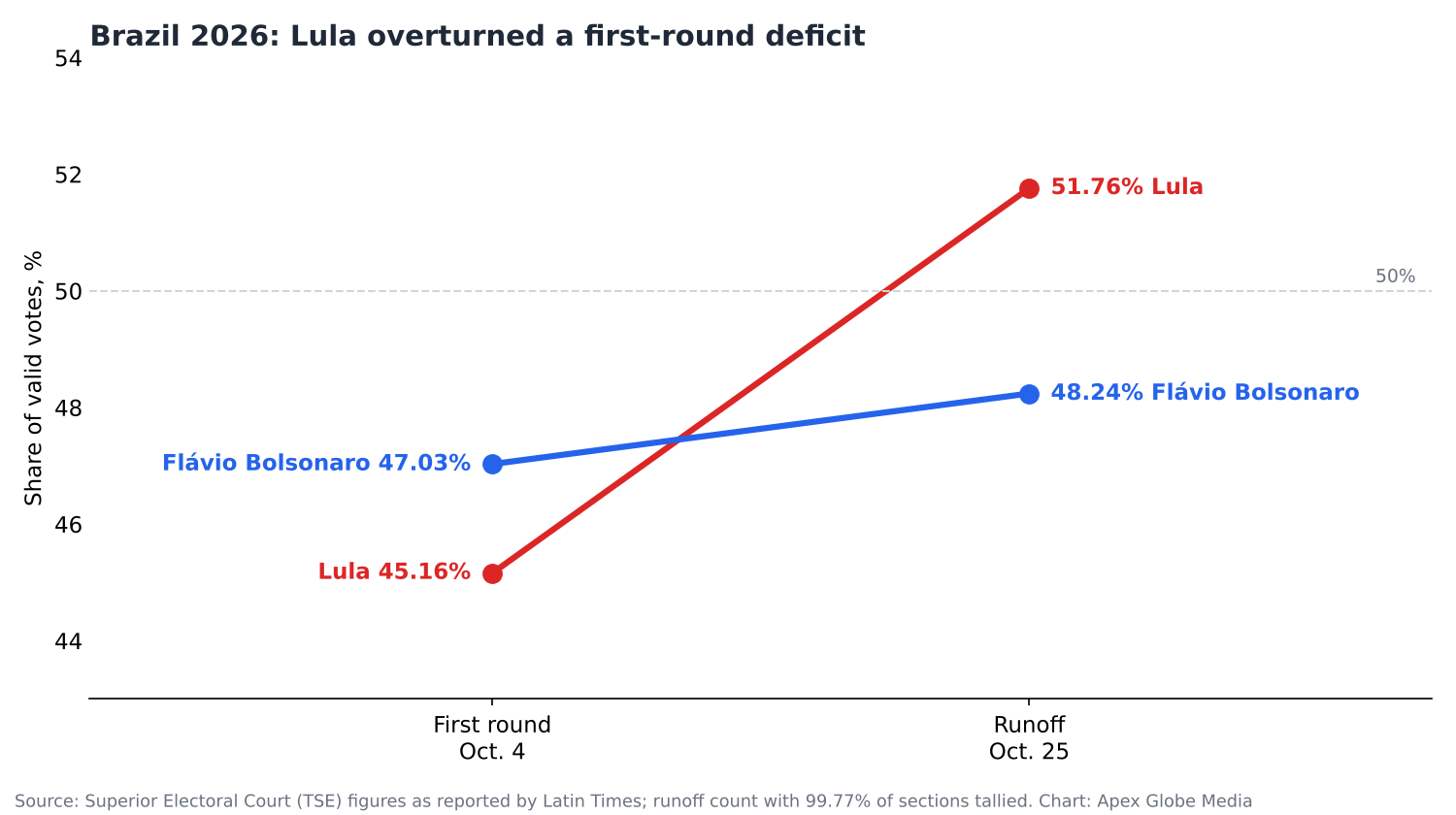
The Brazil election was also a vote on how hard a large democracy can push back against American tech platforms. Luiz Inácio Lula da Silva, who finished second in the first round, won the October 25 runoff against Senator Flávio Bolsonaro with 51.76% of valid votes to 48.24%, according to Superior Electoral Court (TSE) figures reported by Latin Times. At 80, Lula will begin a record fourth term in January. For Meta, Google and X, that means four more years under the government that has done more than any other in Latin America to make them answer for what their users post.
A comeback measured in millions
In the first round on October 4, Flávio Bolsonaro led with 47.03% to Lula’s 45.16%. In three weeks the order flipped. Lula’s margin in the runoff was about 4.3 million votes out of roughly 123.8 million cast. Latin Times and France 24 report that no candidate who trailed in the first round had won a runoff since Brazil returned to democracy. Flávio led for roughly the first half of the count, and Lula pulled ahead only after about 70% of votes were in, as results from his stronghold in the Northeast arrived.
Flávio Bolsonaro, the son of former president Jair Bolsonaro, said it was “impossible to recognize this election” and that his team would seek its annulment, France 24 reported. His complaint centres on a late decision by Supreme Court Justice Cristiano Zanin, who extended voting by two hours after a request from Lula’s side over delays in transporting voters. According to Anadolu Agency, Bolsonaro’s camp also objected that Zanin was once Lula’s lawyer. The extension deserves a review, but a two-hour delay in places still open is unlikely to explain a 4.3 million vote gap.
The campaign fought on Meta’s platforms
Technology was not a side issue in this race. Ten days before the runoff, Lula’s campaign accused Meta of using its algorithms and AI tools to favour Bolsonaro. It said Lula’s posts suffered “unjustified reductions in reach” and that WhatsApp’s built-in Meta AI would create campaign images for Bolsonaro but not for Lula, NBC News reported, citing AP. On October 15 Justice Marco Aurélio Bellizze of the electoral court ordered Meta to treat both candidates equally, including in its AI tool, under threat of a 500,000-real (about $98,000) daily fine. Meta told the court it “is committed to providing equal platform access for all political parties.”
It is an unusual order: a court telling a tech company that its generative AI assistant must be politically even-handed. Whether the bias was real was never proven in public, but other countries’ electoral authorities are likely to take note.
Big Tech’s toughest regulator in the region
The case fits a longer pattern. In 2025 Brazil’s Supreme Court struck down part of the country’s internet law that had shielded platforms from liability for user posts unless they ignored a court order. In its filings with the SEC, Meta says the new framework requires it to remove unlawful content after a private notice and could bring more litigation and enforcement.
Lula went further on May 20, 2026, signing two decrees, the Rio Times reported. Platforms must now proactively remove content in seven categories, including terrorism, attacks on democracy, racism and crimes against children, and can be liable for illegal posts they fail to take down after an out-of-court notice. A second decree requires reported nude images, real or AI-generated, to be deleted within two hours and bans AI tools that create fake nudes. The data protection authority, ANPD, is set to become a broader regulator of digital platforms. A Bolsonaro government would likely have rolled much of this back; Lula’s win locks it in.
Brazil also wants its own AI capacity. Its national AI plan, launched in 2024, commits about 23 billion reais (roughly $4 billion) through 2028 to computing, research and Portuguese-language models, an academic review of the plan notes. In his victory speech Lula said Brazil needs its own artificial intelligence so it does not depend on the US. Critics point out that the chips behind any “sovereign” AI are still imported.
Tech is now part of the trade war
Washington has tied these policies to trade. In July 2025 the US Trade Representative opened a Section 301 investigation into Brazil covering digital trade and Pix, the central bank’s instant payment system that competes with Visa, Mastercard and PayPal, and it flagged Brazilian court orders against US social media companies, Payment Expert reported. Trump had already imposed 50% tariffs on Brazilian goods that year, partly over the prosecution of Jair Bolsonaro, who is now serving a 27-year sentence for a coup plot, Newsweek notes.
Flávio had met Trump in the Oval Office in May and promised closer security ties with Washington. Lula ran on sovereignty instead. “This country will not accept being anyone’s backyard,” he said, according to France 24. We have described how countries are being pushed to pick sides in AI; Brazil has just voted not to pick Washington’s.
Our take
For the tech industry, this election matters more than most outside the US. Brazil has more than 200 million people, a fast-growing market for AI and payments, and a government that now has four more years to turn its platform rules into everyday enforcement. Expect more takedown orders, more fines and more fights over whether AI chatbots treat politicians fairly. Expect Washington to keep linking those fights to tariffs. Companies that hoped a Bolsonaro win would ease the pressure should plan for the opposite.