



OpenAI, Google, Microsoft and Anthropic have agreed to honor a single signal that lets website owners opt out of AI scraping for model training with one line in their robots.txt file, instead of blocking each company’s crawler separately. The shared AI scraping opt-out, announced on October 30, is the first time the four biggest AI developers have backed the same mechanism for respecting publishers’ wishes. It also arrives years after most of the web has already been collected.
What was agreed
According to The Verge, the signal is a shared “policy token” proposed by Kevin Kelley, a technical lead for standards at Anthropic, through the Internet Engineering Task Force (IETF), the body that develops many of the internet’s technical rules. It lives in robots.txt, the plain-text file that for three decades has told automated crawlers which parts of a site they may visit, whether for search indexing, archiving or, more recently, AI training.
Today a site that wants to stay out of AI training has to name each company’s crawler separately: GPTBot for OpenAI, ClaudeBot for Anthropic, Google-Extended for Google, and many more. Every new AI company adds a new name to track. With the shared token, one entry covers every company that honors it, and each of the four says it will respect it.
How to add the signal to robots.txt
The proposal, an Internet-Draft titled “Machine-Readable Training Preference Signal” and dated October 30, names the token __usage_ai-training. It is written where a crawler’s name would normally go, in the User-Agent line, followed by ordinary Disallow and Allow rules. The draft’s own example keeps a whole site out of AI training except for a press-kit folder:
User-Agent: __usage_ai-training
Disallow: /
Allow: /press-kit/
Three details in the draft matter for publishers. The token is about how content may be used, not whether it may be fetched: “This policy token is not a directive for crawling behavior,” it says, so pages can still be crawled, for example for search. If a robots.txt file has no group with the token, no preference has been expressed. And “private agreements MAY override preferences,” which means a site that has signed a licensing deal with an AI company is bound by the deal, not the file. The draft is an individual submission and has no formal IETF standing yet.
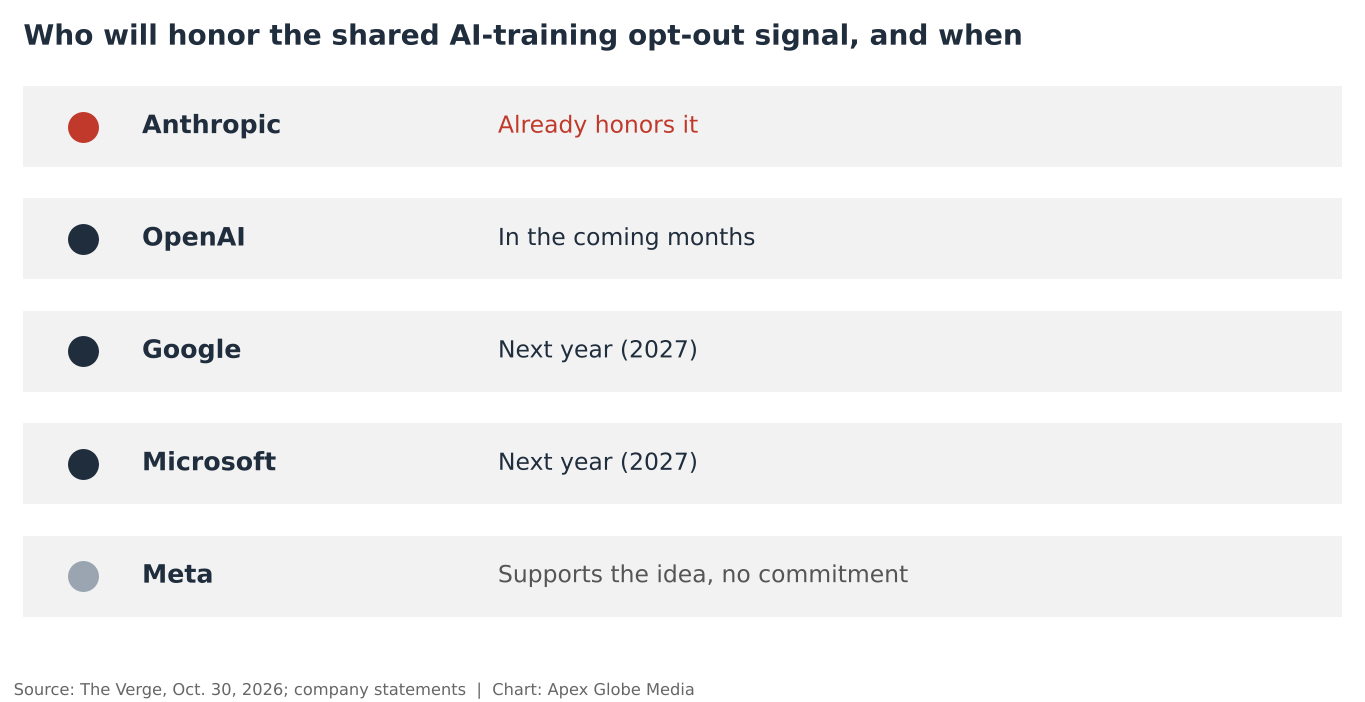
The rollout is gradual. Anthropic has already adopted the signal, OpenAI says it will follow in the “coming months,” and Google and Microsoft plan to support it next year. Microsoft says it will add finer controls that let publishers refuse AI training separately from “grounding”, where an AI system pulls in a page to back up an answer, and that a site’s choice will not affect whether it appears in Bing search. Google already offers similar settings that separate AI use from ordinary search ranking.
Meta, one of the most active crawlers on the web, is not part of the commitment. Its communications head Andy Stone said that “creating a common signal that conveys such preferences to multiple providers at once is an important step,” but did not say whether Meta’s crawlers would honor it, BigGo Finance and The Verge reported.
What it does not do
The signal has clear limits. It is voluntary: there is no enforcement and no penalty for a crawler that ignores it, and robots.txt itself has always been a request rather than a lock. It also works only from now on. Content that AI companies have already scraped and stored is not deleted, which is why Inc. summed it up as “the 4 AI giants just agreed to let websites opt out. They’ve already taken the data.”
Nor does it involve money. The token lets a publisher say no to training, not charge for it, which sets it apart from licensing schemes such as the Really Simple Licensing standard or Cloudflare’s pay-per-crawl tools, which let sites bill AI crawlers. For news organizations whose traffic is falling as people get answers from chatbots, a cleaner “no” does little to replace lost revenue.
Why it matters now
The timing reflects mounting pressure on AI companies. This week Reddit said it will start requiring users to log in to see much of its content, partly to keep AI scrapers out, and Britain’s competition regulator opened an investigation into whether Meta imposed unfair terms on publishers and advertisers to use their content for AI. Anthropic, which is preparing for a stock market listing, and OpenAI, which is expanding ads in ChatGPT, both have reasons to look more cooperative with the publishers whose work trains their models.
For website owners, the practical advice is simple: the new token is worth adding once it is finalised, but it does not replace existing crawler-specific rules, which still matter for Meta and for the many smaller AI companies that have made no promises.
Our take
A single opt-out signal is a real improvement for small publishers who cannot track dozens of crawler names, and it is welcome that the industry’s biggest players are standardising through the IETF rather than inventing their own rules. But it arrives after the largest training datasets were built, it depends entirely on goodwill, and it offers publishers a way to refuse rather than a way to be paid. The next step that matters is not another opt-out button but a fair, enforceable way for the people who create web content to share in the value AI companies build from it.