


Marvell Technology has agreed to buy Lumentum in an all-stock deal worth about $115 billion including debt, the largest tech acquisition of 2026 and one of the biggest chip deals ever. The Marvell Lumentum merger, announced on November 2, joins a maker of custom AI chips with a maker of the lasers and optical parts that carry data between those chips. It is a $115 billion bet that the AI data center boom will keep going, made in the middle of a week when investors have been questioning exactly that.
The terms
Lumentum shareholders will receive 4.5 Marvell shares for each share they own, worth about $1,132, a premium of roughly 24% to Lumentum’s price on October 28, before talks were first reported, according to Reuters, via The Globe and Mail. That gives the deal an equity value of about $102.5 billion; the $115 billion headline figure includes debt. Marvell shareholders will own about 67% of the combined company and Lumentum shareholders about 33%.
Both boards approved the deal unanimously. Marvell chief executive Matt Murphy will keep his job, and three Lumentum directors, including its chief executive Michael Hurlston, will join Marvell’s board. The companies expect more than $1 billion a year in cost savings and plan to close in the first half of 2028, after shareholder and regulatory approvals, Yahoo Finance reported. Axios called it the largest merger ever between two public tech companies.
Why light matters for AI
Modern AI models are trained and run on thousands of chips that must constantly exchange data. Copper wires cannot carry enough data fast enough over the distances inside large data centers, so the industry is shifting to optical links, which send data as pulses of light. Lumentum makes the lasers, optical components and switches that do this, including optical circuit switches, which can reconfigure connections between AI chips on the fly.
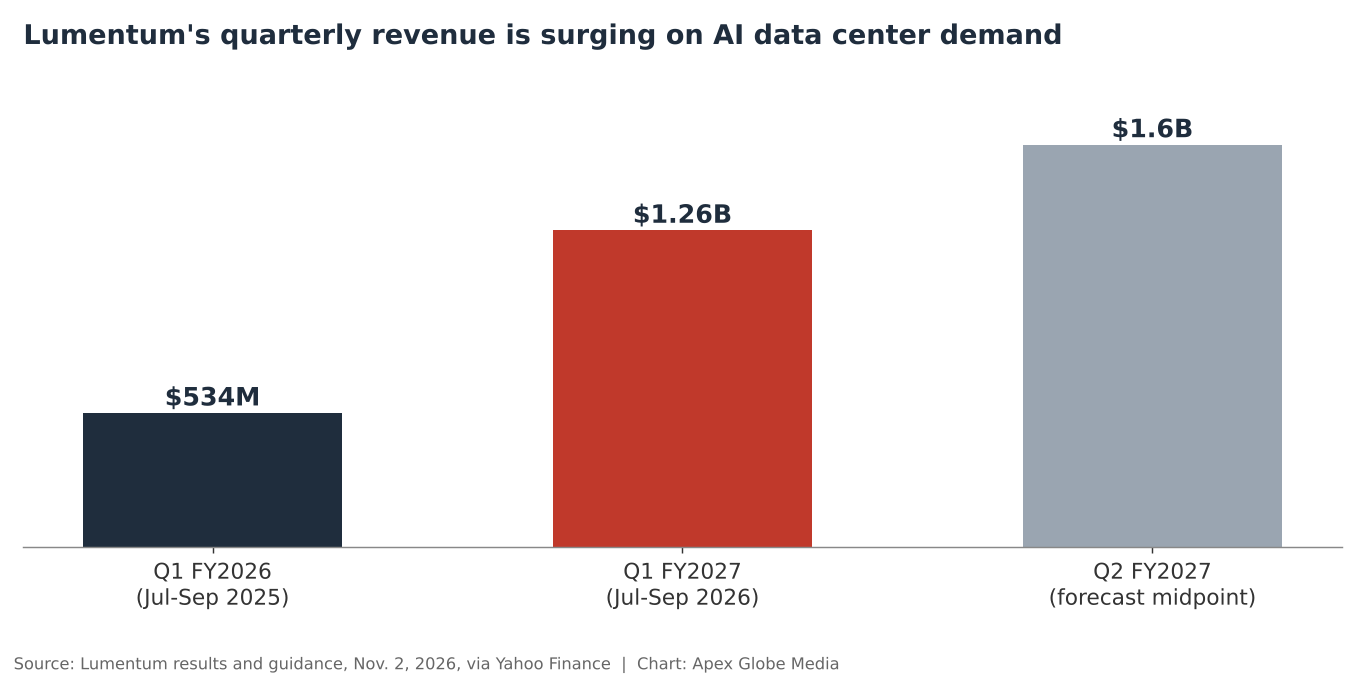
That demand shows up clearly in Lumentum’s numbers, released on the same day. Revenue in its fiscal first quarter, which ended in September, more than doubled to $1.26 billion from $534 million a year earlier, and the company forecast $1.575 billion to $1.625 billion for the current quarter, well above analysts’ expectations. Chief executive Michael Hurlston said pump lasers and optical circuit switches led the growth.
Taking on Broadcom
Marvell designs custom AI chips for cloud giants such as Amazon and, since August, supplies chips that work alongside Google’s AI processors in a deal worth up to $120 billion in sales. Its market value has grown to more than $170 billion. Its main rival is Broadcom, which offers customers a broader range of AI data center hardware under one roof. Buying Lumentum lets Marvell offer both the chips and the optics that connect them, and the companies say it expands their combined addressable market to $550 billion.
Nvidia has a stake in the outcome: it invested $2 billion in each company earlier this year. There is also a policy angle. Lumentum competes with China’s Zhongji Innolight, and a proposed U.S. ban on new Chinese optical transceivers could push more demand toward American suppliers. Marvell has already been building up its optical business, buying Celestial AI for $3.5 billion in February.
A bold bet in a nervous market
The timing is striking. Since talks were first reported in late October, Marvell’s shares had fallen about 22% and Lumentum’s about 8%, as chip stocks slumped after Intel’s worst day since 1974 and growing doubts about AI spending, including reports that OpenAI’s latest funding round fell short of its target. Paying entirely in stock lets Marvell avoid taking on debt, but it also means Lumentum shareholders are betting on Marvell’s share price holding up until 2028.
Our take
This deal makes strategic sense: as AI clusters grow, the connections between chips are becoming as important as the chips themselves, and owning both gives Marvell a stronger hand against Broadcom. But it is also a very expensive bet placed at the peak of an investment cycle, with a closing date 18 months away. If AI data center spending keeps rising, Marvell will look visionary. If the current wobble turns into a real slowdown, it will have issued a third of its company for an optical business priced for perfection. Regulators in the U.S. and China will also have a say, and the deal is likely to become another bargaining chip in the wider fight over AI technology.