



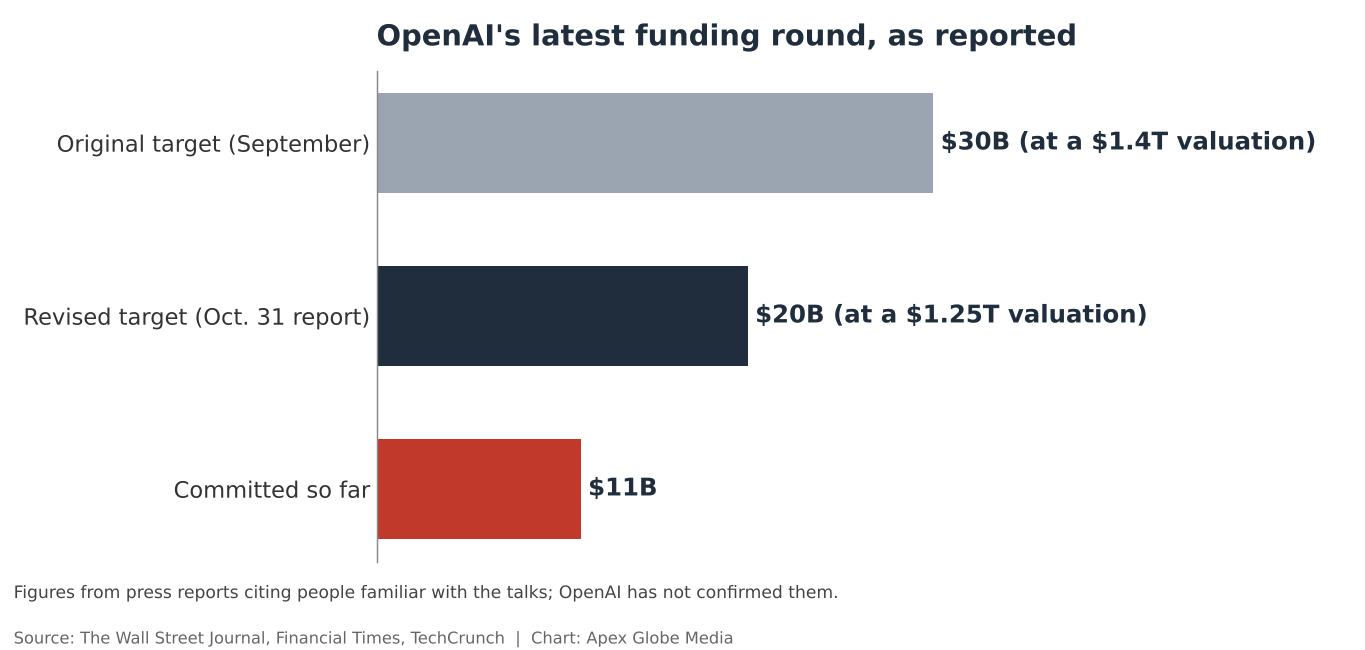
OpenAI has struggled to raise money for the first time in its recent history. The OpenAI funding round that was meant to bring in $30 billion at a $1.4 trillion valuation has so far drawn only about $11 billion in commitments, according to The Wall Street Journal, and the company has cut both its target and its price. The shortfall comes in the middle of a sharp sell-off in AI stocks and is the clearest sign yet that investors are becoming choosier about the huge sums AI companies need.
What has been reported
In late September, TechCrunch reported that OpenAI was in talks to raise at least $30 billion before a stock market listing, at a valuation of about $1.4 trillion. By October 22, reports put the price at $1.25 trillion. On October 30, the Journal reported that OpenAI had secured only about $11 billion, less than half its original goal, citing people familiar with the matter. A day later, the Financial Times reported that OpenAI is now seeking about $20 billion at $1.25 trillion, as some investors cut their commitments amid the sell-off.
According to The Decoder, which summarised the reports, OpenAI now plans to fill the gap with money from family offices and wealthy individuals rather than the large institutions that dominated earlier rounds, and is reportedly planning to go public early next year. OpenAI has not publicly confirmed the figures.
Why investors hesitated
The timing could hardly have been worse. In the last week of October, Alphabet’s free cash flow turned negative under the weight of its AI spending, Amazon reported a $42 billion free cash outflow over twelve months, Meta’s credit outlook was cut to negative by S&P after its plan to raise up to $95 billion, and Intel suffered its worst day since 1974. The Journal also reported that the cost of insuring against debt defaults at the biggest cloud companies has hit its highest level since 2021, and that smaller AI cloud providers such as CoreWeave and Nebius have been effectively shut out of the bond market.
OpenAI also faces direct competition for investors’ money. Anthropic, its closest rival, filed for an IPO in October and disclosed $16.3 billion in revenue, and its listing could pull in a large share of the capital that might otherwise go into OpenAI’s private round. A trillion-dollar private valuation asks investors to accept a price set before the company’s numbers are tested in public markets, at a moment when public markets are punishing AI spending.
What the money is for
OpenAI’s need for cash is enormous. It has signed long-term deals for computing capacity worth hundreds of billions of dollars with partners including Microsoft, Oracle, Nvidia, AMD and Broadcom, and it is building data centers under its Stargate project. Revenue is growing quickly, helped by consumer subscriptions, business sales and advertising in ChatGPT, but nowhere near fast enough to cover those commitments on its own. Every round of fundraising is therefore also a vote of confidence in its ability to keep paying for chips and power.
Even $11 billion is a vast amount by any normal standard, and $20 billion would still be one of the largest private rounds ever. A valuation of $1.25 trillion would make OpenAI more valuable than all but a handful of public companies. The story is not that OpenAI cannot raise money, but that it can no longer raise unlimited money at any price.
Our take
For two years, AI fundraising worked on the assumption that the biggest labs could always find more capital at a higher price. That assumption broke this week. A smaller round at a lower valuation is not a crisis for OpenAI, but it changes the balance of power: investors can now ask harder questions about profits, computing contracts and governance before writing cheques. That is healthy for an industry spending trillions on infrastructure. The real test comes when OpenAI and Anthropic face public markets, where valuations are set every day, not negotiated once a year.