



Apple will start looking inside files and photos that iCloud users share through public links. In a support document published this week, the company said that from iOS 27.3 and its companion updates, “items shared using Anyone with the Link will be checked by Apple for harmful content,” and that it may delete such content or disable the accounts behind it. The iCloud link scanning plan is narrow in scope, but it is a notable step for a company that has built much of its brand on privacy, and it leaves a key question unanswered: what counts as harmful.
What is changing
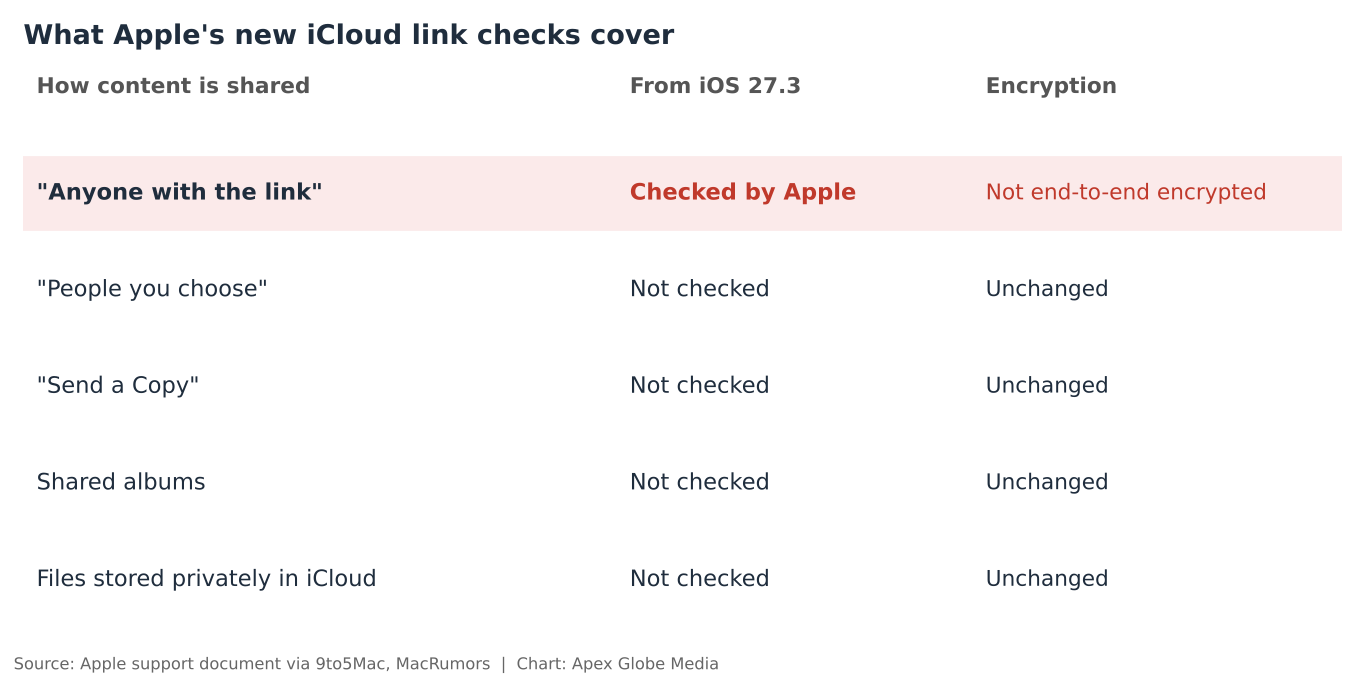
The change applies to version 27.3 or later of iOS, iPadOS, macOS and visionOS, which are currently in developer testing and expected to be released in December, MacRumors reported. It covers content stored in iCloud, such as a photo in iCloud Photos or a file in iCloud Drive, when the owner shares it with the “Anyone with the link” option, which lets anyone who has the URL open the item without signing in.
Other ways of sharing are not affected. Links limited to “People you choose,” files sent with “Send a Copy,” shared albums and content simply stored in a user’s iCloud account are excluded, according to MacRumors and 9to5Mac. Apple has not said whether links created before the update will also be checked.
What Apple may do
The enforcement language is broad. Apple says it “reserves the right to move, refuse, modify, remove, or delete the content at any time.” For users who upload harmful content, it may take action against their Apple Account, “including blocking or disabling your Apple Account,” block new accounts created with the same email address or phone number, and, “if necessary,” involve law enforcement.
Apple does not define “harmful content” or explain how the checks will work. MacRumors suggests it could cover malware and malicious files as well as child sexual abuse material (CSAM), given the reference to law enforcement. The Verge reported that the move follows protests calling on Apple to do more against abuse material stored in iCloud.
The encryption question
Apple’s support document makes one technical point clear: content made available to anyone through a public link is not end-to-end encrypted, even for users who have turned on Advanced Data Protection, Apple’s strongest encryption setting. That has always been true by design, because a link that anyone can open must be readable by Apple’s servers. The difference now is that Apple will actively check what is behind those links.
That distinction matters for Apple’s history. In 2021, the company proposed scanning photos on users’ devices for known abuse images before they were uploaded to iCloud, then shelved the plan after privacy experts warned it could be expanded to other kinds of content, and later dropped it. The new approach is far more limited: it looks only at material a user has chosen to make public, which is closer to how file-sharing services such as Google Drive and Dropbox already police public links.
Early reaction has still been sceptical, mostly because of the vague wording. One user quoted by 9to5Mac complained about “paying for icloud so apple can decide what harmful means later.” For people who want to share private files without any checks, the practical advice is simple: use “People you choose” instead of a public link.
Our take
Checking publicly shared links for abuse material and malware is reasonable, and arguably overdue: a public link is a way of publishing, and Apple is right not to let iCloud become an anonymous distribution channel. But Apple’s own standards for privacy should apply to how it does this. A company that asks users to trust it with their photos and documents should say clearly what “harmful content” means, how the checks are performed, how mistakes can be appealed and whether old links are included. Account bans on the basis of an undefined rule are exactly the kind of overreach Apple has criticised in others. A short, precise policy would cost Apple nothing and would protect both its users and its reputation.