


Nvidia’s board has opened an independent Nvidia investigation into its own chief executive. On Sunday, the board said Jensen Huang had been the target of a “foreign intelligence effort”, and in an email to staff Huang admitted he had been “unfaithful to my wife”. On Monday, November 9, the world’s most valuable chipmaker lost more than 6% of its value, CNBC reported.
The probe centres on Huang’s relationship with Alice Huang, an executive at the Singapore-based cloud company Megaspeed, an Nvidia customer. US intelligence officials believe she was recruited by China’s Ministry of State Security. We reported the first details of that assessment on Saturday in our story on the Chinese spy report around Jensen Huang, and earlier on Megaspeed’s ties to Nvidia.
What the board and Huang said
The independent directors will run the review with outside lawyers. The board said Huang “fully supports the review” and will keep leading the company while it runs. It also said it has no reason to believe that US national security or Nvidia’s secrets were compromised, and that it has confidence in his leadership.
In his email, Huang said he had “fallen short” of his responsibility to colleagues, the board, partners and shareholders. “I am deeply sorry,” he wrote, and apologised to his wife and children. Before the board acted, Nvidia had played down the contacts, saying there was “nothing unusual or unexpected” about them, according to the Financial Times.
China rejects the story. Foreign Ministry spokesperson Guo Jiakun called the espionage claims “entirely baseless”, CBS News reported, and Chinese state media accused US outlets of inventing a spy narrative.
Investors take a hit
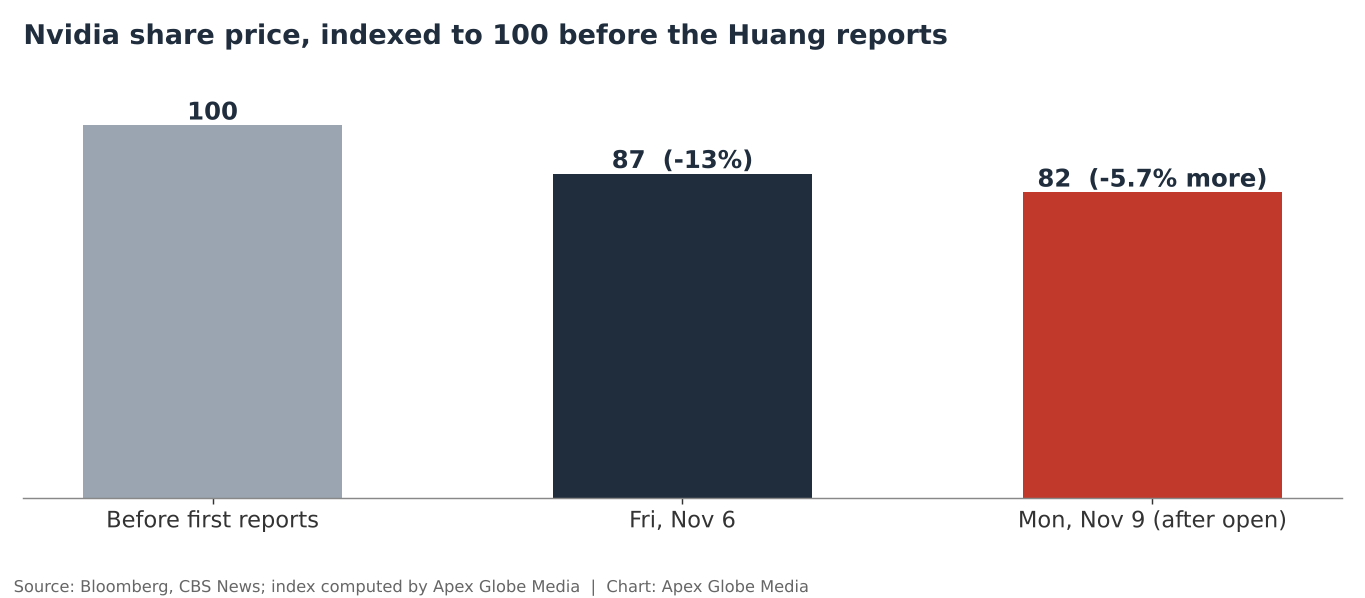
Shares fell 5.7% to $176.24 shortly after Monday’s open, according to CBS. They had already dropped about 13% since the first reports about the relationship, Bloomberg said, and nearly 20% over the past month amid a wider sell-off in AI stocks after the US midterms, which we covered in our report on the post-election crash. Other chipmakers, including AMD, Arm, Intel and Qualcomm, rose on Monday, which suggests investors see this as an Nvidia problem, not a sector problem.
Analysts are split on what comes next. Dan Ives of Yorkville Ives called it “a black eye moment for Jensen” and said there is “clearly risk” that he could be removed, depending on what the board finds. At the same time he dismissed talk of an immediate replacement and said Nvidia remains two to three years ahead of China in AI chips. Adam Crisafulli of Vital Knowledge warned that the affair could lead Washington to tighten export rules on Nvidia chips. President Trump called Huang “an honorable guy” but said he had not discussed the case with him.
Why it matters for the AI race
Huang is not an ordinary CEO. He co-founded Nvidia in 1993, owns about 3.56% of it and manages more than 60 direct reports, according to The New York Times. He is also Nvidia’s main voice in Washington, where he has lobbied for looser limits on chip sales to China. This year Trump approved sales of the H200 chip to Chinese buyers, a deal that now looks politically harder to defend. We have reported how those shipments are already stuck in Hong Kong.
The timing is bad. Nvidia reports quarterly results on November 17 and holds a major conference in Washington at the end of the month. A new Democratic majority in Congress has already said it wants closer oversight of Nvidia’s exports.
Our take
The board had little choice. When US intelligence says a foreign agent got close to the man who decides where the world’s most important AI chips go, “nothing unusual” is not an answer investors or lawmakers will accept. The independent review is the right step, and the board’s early vote of confidence suggests it wants to keep Huang. The real risk is not a change of CEO but a change of policy. If Washington decides that Nvidia’s China lobbying was shaped by a security failure, the export rules will get tighter, and that would cost Nvidia far more than one bad week on the stock market.