

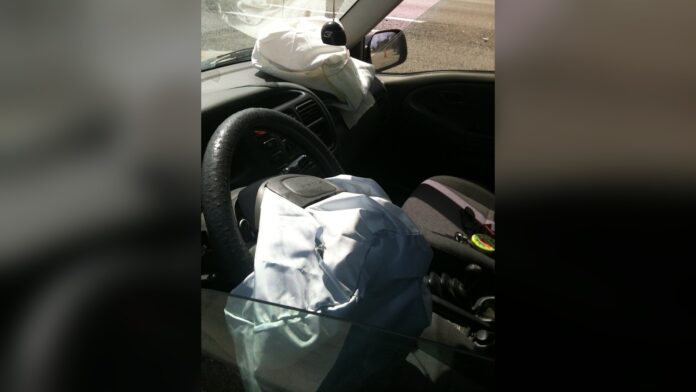

Honda and Toyota are recalling about 1.6 million cars, trucks and SUVs over the risk that their Takata airbag inflators could rupture, Reuters reported on Friday. Both companies say no crashes, injuries or ruptures have been tied to these vehicles. What makes this recall different from the dozens before it is the part being replaced: these inflators contain a drying agent, the design that US regulators decided in 2020 did not need to be recalled.
The recall covers 810,592 older Honda and Acura vehicles in the United States and about 790,000 Toyota and Lexus vehicles worldwide, including 314,000 in the US. Some of the Toyotas are cars whose owners already did the right thing years ago: they went to a dealer for the original Takata recall and received one of these inflators as the replacement.
Which cars are affected
On the Honda side, the recall covers some 2013 Accords, 2012 and 2013 Civics, 2012 and 2013 CR-Vs, and the 2013 Acura ILX and RDX. It applies only to vehicles originally sold or registered in 14 hot and humid states and territories: Alabama, California, Florida, Georgia, Hawaii, Louisiana, Mississippi, South Carolina, Texas, Puerto Rico, the US Virgin Islands, the Northern Mariana Islands, Guam and American Samoa, according to Reuters’ report carried by ABC News. Honda said long-term monitoring had revealed possible propellant degradation in some inflators within specific regions.
Toyota’s US recall is detailed in its safety recall report filed with the National Highway Traffic Safety Administration (NHTSA) on November 12. It involves 314,029 vehicles and only the front passenger airbag inflator. Almost three quarters of them are 2003 to 2008 Toyota Corollas.
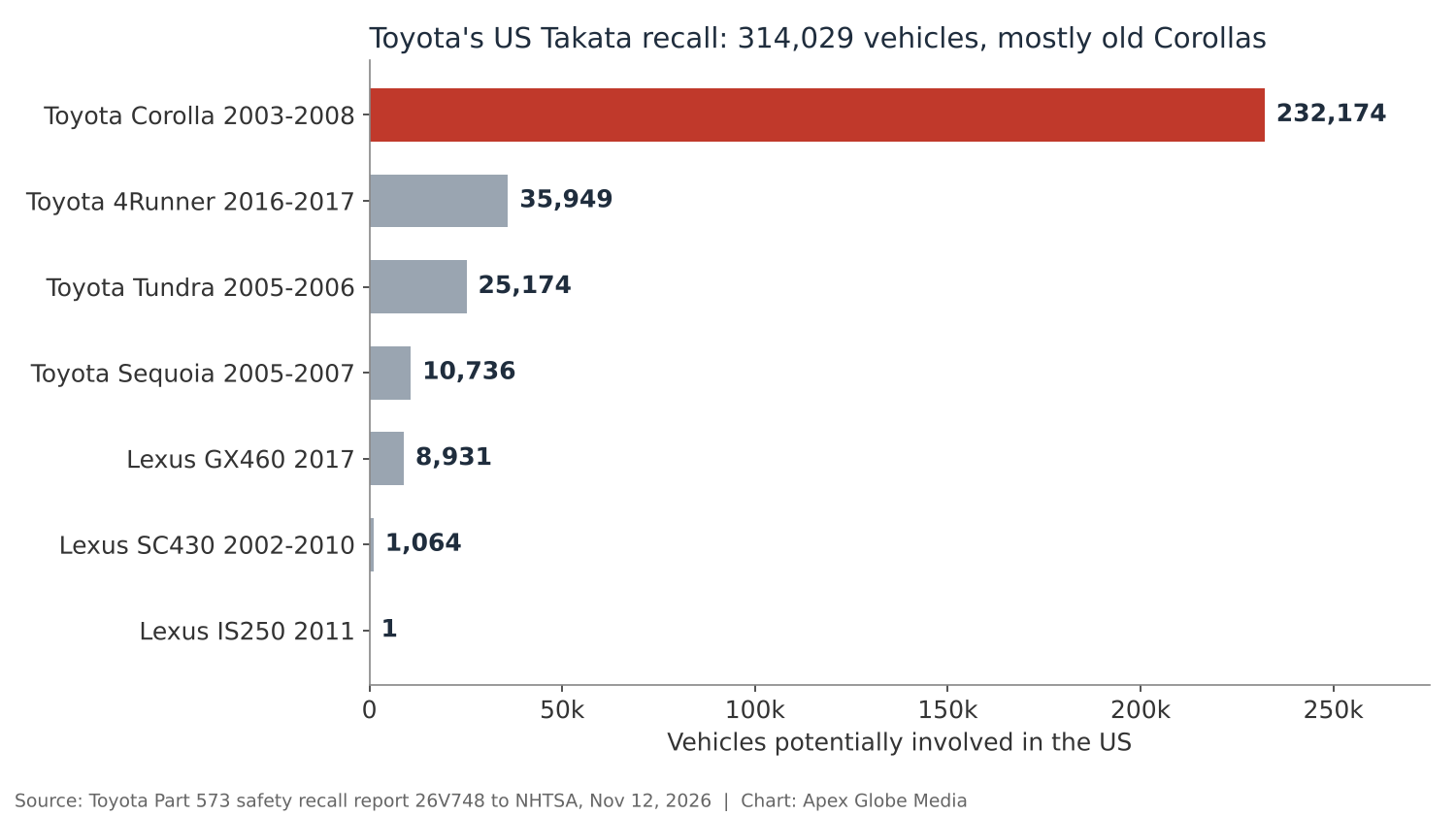
The rest are 2016 and 2017 4Runners, 2005 and 2006 Tundras, 2005 to 2007 Sequoias, the 2017 Lexus GX460, the 2002 to 2010 Lexus SC430 and, in one case, a single 2011 Lexus IS250. Toyota has not said which US states its recall applies to. Owners will receive letters between December 28 and January 11, and Toyota expects replacement inflators to be ready by early 2027. Depending on the model, dealers will replace the inflator or the whole airbag assembly, free of charge.
Why a “safe” Takata design is being recalled now
Takata’s inflators use ammonium nitrate as a propellant, a cheap chemical that can break down after years of heat and humidity. When that happens, the inflator can burn too fast when the airbag fires, and its metal housing can burst, sending fragments into the cabin. There have been at least 28 deaths and more than 400 injuries in the United States linked to defective Takata inflators since 2009, Reuters reported. Every one of those deaths involved inflators without a drying agent, and at least 20 happened in Hondas.
Later Takata inflators added a desiccant, a moisture-absorbing material meant to keep the propellant dry. In May 2020, NHTSA decided not to require a recall of about 56 million of these desiccated inflators, saying they did not pose a safety risk at that time but that it would keep monitoring them. It did order a smaller recall of about 370,000 Volkswagen vehicles whose desiccated inflators looked riskier. Safety advocates criticised the decision because the agency relied on testing by the industry rather than its own.
The new recalls do not mean a desiccated inflator has exploded. Toyota’s filing says it has been collecting and testing these inflators since 2016 and has seen “no measurable degradation” of the propellant, and no ruptures in the field. The reason for acting is age. Takata’s successor company published a model of each inflator’s “safe service life” in November 2021, which Toyota describes as more conservative than an earlier model by an industry testing group. By that estimate, these inflators “will approach the end of their estimated” safe life, so Toyota decided on November 6 to replace them “out of an abundance of caution.”
NHTSA framed it the same way. “Honda and Toyota saw early evidence of degradation risk in certain of their vehicles and are currently conducting proactive recalls of vehicles,” the agency said late on Friday, adding that other carmakers are still analysing and testing their inflators.
The fix that now needs fixing
The most uncomfortable detail is in Toyota’s filing. It says the recalled vehicles carry the passenger inflators either as original equipment “or a replacement part under a prior recall.” In other words, some of these Corollas, Tundras and Sequoias were already brought in for the first Takata recall and given a desiccated Takata inflator as the replacement. More than a decade later, those owners have to go back again.
It is not the first time a Takata replacement part has needed its own recall. In 2019, Honda recalled about 1.1 million vehicles to swap out desiccated driver-side replacement inflators after manufacturing errors at a Takata plant. The pattern is a reminder that, during the largest recall in US history, carmakers were racing to find enough parts, and some of the parts they used were a stopgap.
The ages of the cars matter too. The recalled vehicles are between 13 and more than 20 years old and have had several owners. Recall letters go to the registered owner, and older cars are the ones most likely to have changed hands without the paperwork following them. That is one reason the original Takata campaign dragged on for years: over the past decade, two dozen carmakers have recalled more than 100 million vehicles with Takata inflators worldwide, about 67 million of them in the US.
What owners should do
Anyone with one of the listed models should enter their 17-character vehicle identification number (VIN) on NHTSA’s recall lookup or on the Honda or Toyota owner sites. Toyota’s owner letters only go out from late December, so a car that does not show up today may still be added as the recall rolls out. Repairs are free at franchised dealers, including for second and third owners.
Neither company has reported a failure in these vehicles, and both describe the recall as a preventive step. Regulators have been tightening scrutiny of ageing safety systems in other areas too, such as the FAA’s new checks on older Boeing 737s.
Our take
This is the recall working the way it is supposed to, for once: the companies acted on a model of when the parts would wear out, before anyone was hurt. But it also shows what NHTSA’s 2020 decision really was. It was not a finding that desiccated inflators are safe forever, only that they were safe for now, and “now” is running out for the oldest of them. With tens of millions of desiccated inflators still on US roads, Honda and Toyota are unlikely to be the last. The agency should publish the testing data behind these decisions, so owners of other brands can see how much safe life their airbags have left, instead of waiting for the next filing.