

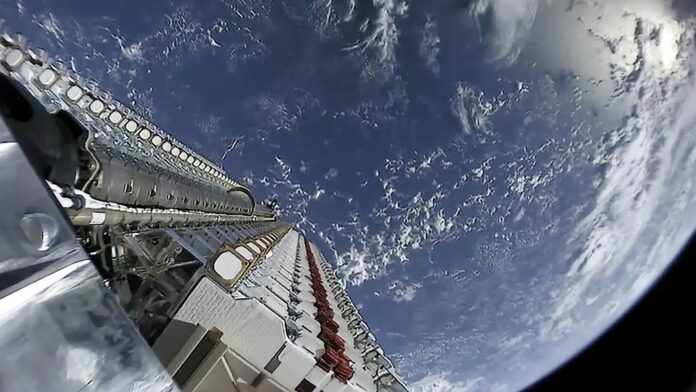

The US Federal Communications Commission has cleared SpaceX to put up to one million orbital data center satellites into low Earth orbit. In an announcement on November 25, the FCC called the grant for the constellation, named Starmind, “the first authorization in U.S. history for a constellation of data centers in space.” Chairman Brendan Carr tied it directly to the AI race, saying the approval “opens a bold new frontier for the computing infrastructure needed to power America’s leadership and growth.”
The number is huge. About a million satellites is far more than every spacecraft humanity has launched so far put together. But the order itself, issued by the FCC’s Space Bureau, is narrower than the headline. It licenses radio links used as a backup. It leaves the hardest debris question for later. And it says nothing about whether computing in orbit can actually work or pay off.
What SpaceX actually got
The FCC regulates radio spectrum, so a satellite licence is, legally, a licence to transmit. Starmind satellites are meant to talk to each other mainly through laser links, which the FCC does not license. They would pass data to SpaceX’s existing Starlink internet satellites, which then route it down to ground stations.
What the order covers is a Ka-band radio system for “backup and emergency telemetry, tracking, and command”, the channel operators use to check on a satellite and steer it when something goes wrong. The bands are 18.8–19.3 GHz for space-to-Earth links and 28.6–29.1 GHz for Earth-to-space links. SpaceX must use them on an “unprotected and non-interference basis”. That means it gets no protection from other users and must shut down any transmission that is shown to cause harmful interference. Every six months it also has to report how many satellites it has in orbit, how many close approaches with other objects it dealt with, how many satellites failed or re-entered, and how many used the radio links.
The satellites will sit in six orbital shells between 500 and 1,002 kilometres up, SiliconANGLE reported. SpaceX’s application, filed on January 30, had asked for altitudes up to 2,000 kilometres.
The debris question is still open
The most important condition concerns space junk. The Space Bureau found SpaceX’s debris plan acceptable only for satellites flying below 600 kilometres. Four of the six shells are above that line. Before SpaceX puts a single Starmind satellite there, it must file a modification with a final debris plan and get it approved.
Altitude matters because of air drag. A dead satellite at 500 kilometres falls back and burns up within a few years. Higher up, the thin atmosphere takes far longer to pull it down, so a failed satellite becomes a long-lived hazard for everyone else. SpaceX had asked to send some high-altitude satellites at the end of their lives into disposal orbits around Earth, or even around the Sun, instead of having them re-enter. The bureau deferred that request, saying SpaceX had not given it enough information to judge whether the idea complies with the rules.
SpaceX told the regulator it will first launch satellites to low test orbits to check that they work before raising them, keep collision avoidance active until just before re-entry, steer re-entries over the ocean and design the satellites to burn up completely. The order accepts those measures for the lower shells. For the upper shells, the work is not done.
The deadlines, and how low the first bar is
The licence runs for 15 years, starting from the day SpaceX certifies that its first Starmind satellite is in orbit and working. It comes with a deployment schedule. If SpaceX misses any step, the authorization becomes “null and void”.
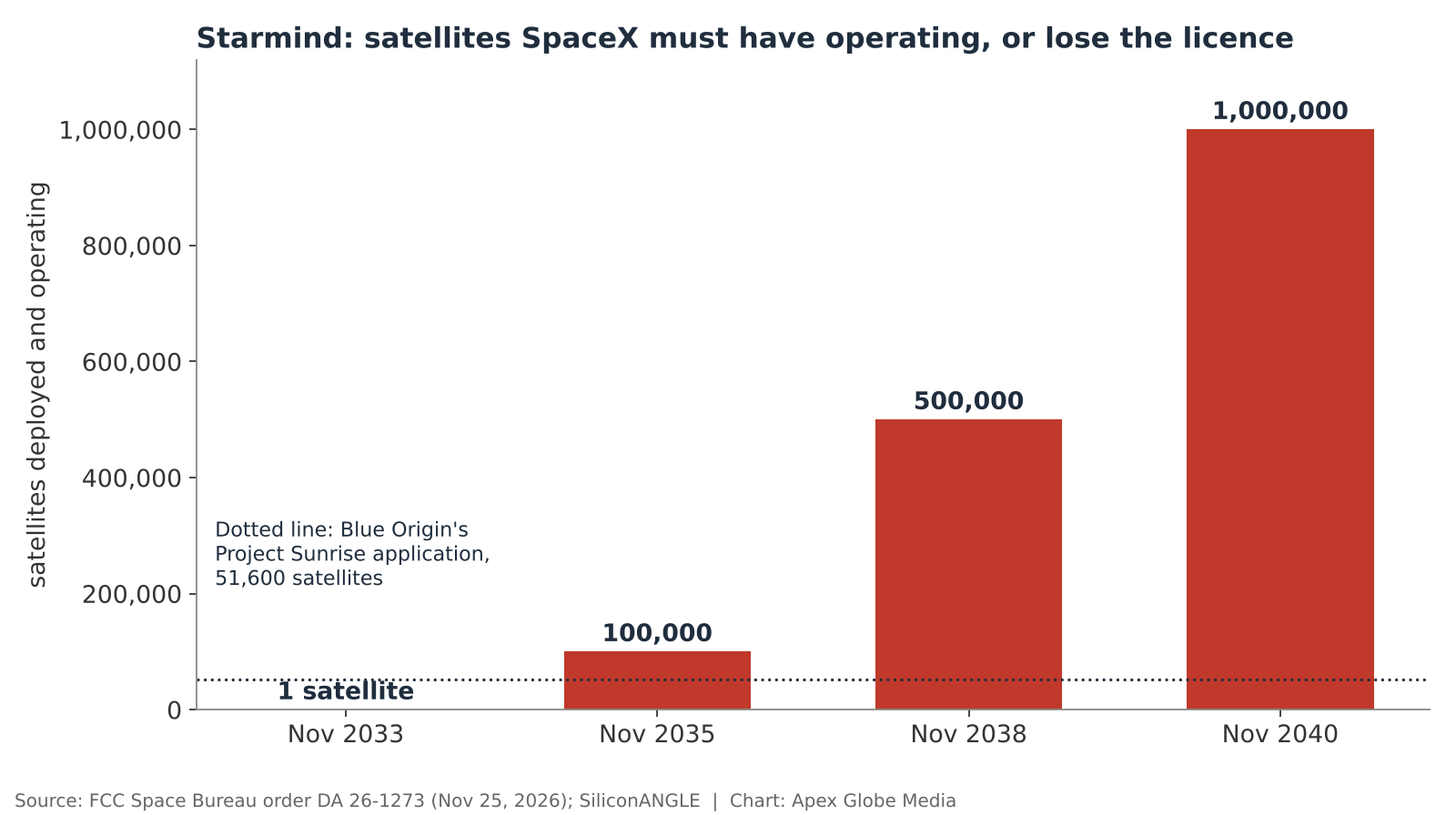
The first step is a single satellite operating by November 25, 2033, seven years from now. Elon Musk has said the first-generation Starmind satellite, called AI1 and built around a space-adapted version of Nvidia’s Vera Rubin NVL72 rack system, could reach orbit as early as the third quarter of 2027, according to SiliconANGLE. If that happens, the first milestone is met six years early. The steep part comes later: 10% of the constellation (100,000 satellites) by 2035, half by 2038 and all of it by 2040.
The bureau also waived the surety bond, the money satellite operators normally have to deposit with the US Treasury to show they are serious about launching. SpaceX had first asked for the milestone rules to be waived too, then withdrew that request and accepted the FCC’s newer milestone schedule. The bureau said that made objections to a waiver moot.
Who objected, and why they lost
Amazon’s satellite unit Kuiper Systems (now Amazon Leo), satellite operator Viasat and the American Astronomical Society all filed petitions to deny the application in March. All three were rejected. Amazon had called the plan “a lofty ambition rather than a real plan,” SiliconANGLE reported. Amazon’s own constellation has had a hard month: as we reported, a Vulcan rocket failure destroyed 40 Amazon Leo satellites on November 15.
The bureau’s answers to the objections say a lot about how far this approval really goes:
- Too many satellites? The order says the FCC’s rules “do not place limits on the number of space stations that can be authorized.”
- Does an orbital data center even make sense? Many public comments doubted the technology or the economics. The bureau found that this was not a reason to deny the licence. It did not rule on the business case at all.
- Astronomy. The FCC said SpaceX’s promise to coordinate with the National Science Foundation was enough to deal with the brightness of the satellites in telescope images. The astronomers’ second worry, that a million computers in orbit would dump enough waste heat to brighten the infrared sky, was treated as outside the scope of a radio licence.
- Environment. Citing an FCC decision from October, the bureau said space operations are not “major federal actions” under the National Environmental Policy Act, so no environmental review was required.
SpaceX has 30 days to decline the grant if it does not accept the conditions. It almost certainly will accept them. Musk replied to Carr on X that Starmind “will be a great asset to America and the world.”
A race for computing in orbit
The idea behind orbital data centers is simple to state. AI computing needs huge amounts of electricity, and on Earth new data centers are running into limits on power grids, water and local opposition. In a sun-synchronous orbit, solar panels can get sunlight almost all the time. The hard parts are getting rid of heat in a vacuum, protecting chips from radiation, living with no way to repair hardware, and moving enormous volumes of data back to the ground.
SpaceX is not alone. The FCC said it is reviewing “additional orbital data center proposals”. Blue Origin applied in March for Project Sunrise, a network of up to 51,600 data center satellites, and Starcloud, a startup, raised $250 million at a $2.3 billion valuation in August, SiliconANGLE reported. Google is working on its own version: last week we covered how Google booked Blue Origin’s New Glenn to launch its first Project Suncatcher satellites in 2029.
Starmind also matters to SpaceX as a company. It applied for the system in January, shortly before it acquired Musk’s AI company xAI, and orbital data centers were part of its pitch to investors before its record stock market listing in June. Now SpaceX and Tesla are trying to close a $3.5 trillion merger by year-end. A federal “first in history” licence is a useful thing to have in that story.
Our take
The honest headline is this: SpaceX now has permission to use backup radio channels on up to a million satellites, plus a debris approval for the lowest shells only. That is a real step, and Starmind is the first project of its kind to get this far. But nobody at the FCC has checked whether a data center in orbit can cool itself, survive radiation or make money, and the order says so openly. The FCC is also waving through very large questions, like the limits of orbital space and the infrared sky, as being outside its job, so in practice no one is answering them. With a first milestone of one working satellite in seven years, the licence costs SpaceX very little while giving it a strong story for investors during a merger. We think the engineering will decide Starmind’s future, not this approval, and the first real test is whether AI1 flies in 2027 as Musk says.