

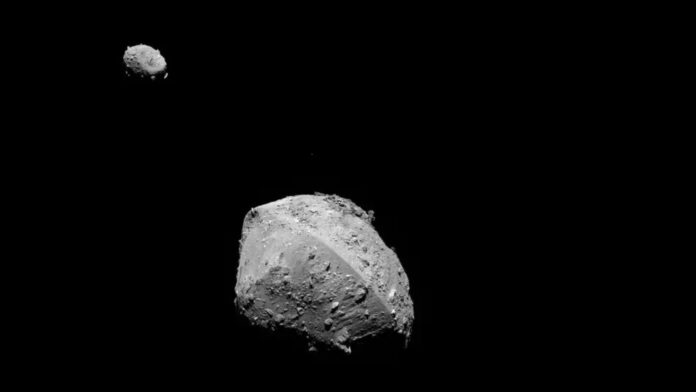

Four years after NASA deliberately crashed a spacecraft into an asteroid, Europe has finally seen the damage. The European Space Agency’s Hera probe has sent back its first close-up images of Dimorphos, and they show a Dimorphos crater the size of a sports stadium that has flattened a whole face of the asteroid. “Scientists debated whether Dimorphos had sustained an impact crater, changed its shape or stayed the same,” Hera’s principal investigator Patrick Michel said in ESA’s announcement. “Much to our surprise the answer turns out to be all three at once!”
The images also brought two surprises nobody planned for. Dimorphos is now tumbling chaotically, and the asteroid pair is surrounded by hundreds of previously unknown boulders, which now threaten the two small satellites Hera is about to release.
What DART did in 2022
Dimorphos is a small moonlet, about 151 metres across, that orbits a larger asteroid called Didymos, about 730 metres wide. Neither poses any danger to Earth. They were chosen because Dimorphos is the size of the asteroids that could one day threaten a city, and because a moon in orbit around another body makes it easy to measure any change from Earth.
On September 26, 2022, NASA’s DART spacecraft (Double Asteroid Redirection Test) hit Dimorphos at about 6.1 kilometres per second, Physics World notes. Telescopes then showed that Dimorphos’s orbit around Didymos had shrunk from 11 hours 55 minutes to 11 hours 23 minutes. That change of about 33 minutes was much bigger than predicted. It proved that a “kinetic impactor”, a spacecraft used as a battering ram, can move an asteroid.
What no one could see was what the hit did to the asteroid itself. DART was destroyed in the crash, and the small Italian cubesat that flew past seconds later only got a distant look. Hera, launched in October 2024, was built to go back and answer that question.
A crater as wide as the asteroid
The crater is bigger than many scientists expected. “The face struck by DART has been flattened into an impact crater the size of a sports stadium, which extends across the asteroid’s entire width,” Michel said. “It’s a big crater that is almost as large as the body itself, which is really spectacular,” Hera team scientist Sabina Raducan told a briefing in Berlin, CNN reported.
The rest of Dimorphos looks almost untouched. The boulder fields on its other sides appear just as they did in DART’s 2022 photos. That fits the long-held suspicion that Dimorphos is a “rubble pile”, a loose heap of rocks held together by weak gravity, rather than a single solid rock. A rubble pile absorbs a hit very differently from solid stone. It throws out far more material, and the push from that flying debris is the most likely reason the orbit changed more than models said it would.
Tumbling “like a barrel thrown down the stairs”
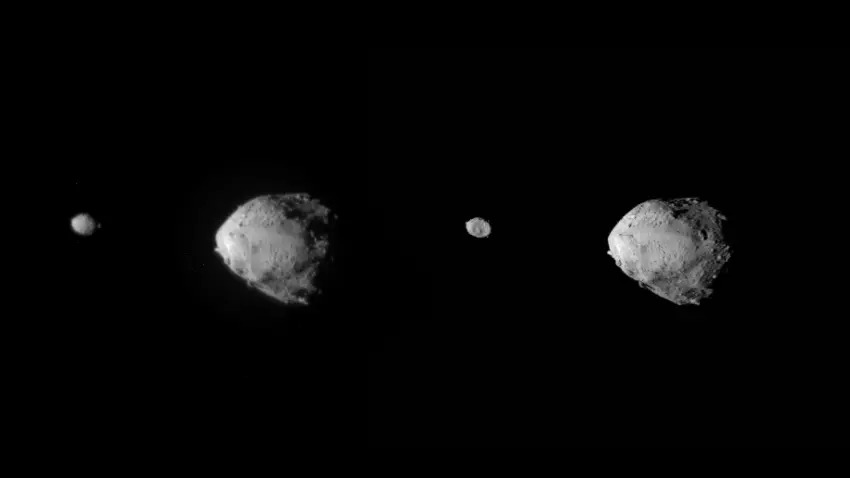
Before the impact, Dimorphos behaved like our Moon, always showing the same face to Didymos. Not any more. “Dimorphos is now tumbling in a chaotic way,” said ESA’s Hera mission scientist Michael Kueppers. Raducan was more vivid: the moonlet now moves like a “barrel that you throw down the stairs”, she said, according to CNN.
The tumbling shows how much energy DART put into the asteroid, beyond just changing its orbit. For planetary defence, this detail matters. A deflection mission needs to know how an asteroid will respond to a hit, and how much of the energy goes into motion, spin and shattering.
Hundreds of boulders nobody had seen
The biggest surprise is the company the asteroids keep. Hera found hundreds of boulders, a few metres across or smaller, orbiting the pair. More than 100 are between the size of a football and a washing machine, said Naomi Murdoch of the University of Toulouse. “As we approached Didymos and Dimorphos, we quickly realized the asteroids were not alone,” she said. “In fact, they had a lot of company.”
Nobody yet knows where they come from. “We cannot say today, with the information that we have, whether these were debris coming from the DART impact or whether there’s another origin, for example, coming off the primary asteroid,” Murdoch said. DART may simply have been moving too fast to spot them in 2022, Raducan added.
The boulders are now an engineering problem. In January 2027 Hera is due to release two shoebox-sized cubesats. Juventas, led by Luxembourg, carries the smallest radar ever flown in space and will try to look inside an asteroid for the first time before attempting a landing. Milani, led by Italy, will study the asteroids’ minerals and dust. Margherita Cardi of Tyvak International, who oversees Milani, called the discovery of the boulders a “nightmare” for her team. “There is a mix of excitement and panic,” she said.
What Hera does next
Hera is a spacecraft the size of a small car. It currently flies about 25 to 30 kilometres from the asteroids, at an average speed of just 12 centimetres per second, using its thrusters to hold its path around two bodies with almost no gravity. It has been using three instruments: a black-and-white framing camera, the Hyperscout H imager that sees in 25 colours at once, and a thermal infrared camera supplied by Japan’s space agency JAXA.
In December, Hera is due to move in to about 13 kilometres. From there it should measure the mass of Dimorphos, the missing number needed to calculate exactly how much push DART delivered. “With the Hera measurements of the mass, we will then be able to see exactly how effective and efficient the DART impact was,” Murdoch said. Those results will feed the computer models that would be used to plan a real deflection.
Hera was built by a consortium of 18 ESA member states led by OHB in Germany. It is ESA’s first planetary defence mission, but not its last. ESA and JAXA are developing Ramses, a mission to the asteroid Apophis, which will pass about 32,000 kilometres above Earth on April 13, 2029, closer than many communications satellites. It is the second big European deep-space milestone in a week, after BepiColombo entered orbit around Mercury.
Hera mission manager Ian Carnelli unveiled the images in the dinosaur hall of Berlin’s natural history museum. “Sixty-six million years ago, an asteroid impact changed the course of life on Earth,” he said. “Today, for the first time in history, humanity is validating how to prevent such an event from happening again.”
Our take
The first planetary defence test has turned out to be messier, and more useful, than anyone expected. One small spacecraft dug a crater across a whole asteroid, set it tumbling and may have filled its neighbourhood with boulders. That is good news and a warning at the same time. Rubble-pile asteroids are clearly easy to push, but they react in ways that are hard to predict, and a real deflection would need exactly that prediction to be right. We think the most valuable number in this mission is still to come: the mass of Dimorphos in December. It will tell us whether hitting an asteroid is a reliable tool or just a lucky one, and that is the kind of science worth paying for.