


Anthropic has released two new AI models, Claude Fable 5.2 and Claude Mythos 5.2, and says that during testing they solved two open problems in black hole physics. In the same announcement on November 9, the company said a team of about 1,000 Fable 5.2 agents rebuilt a computer-checked version of the proof of Fermat’s Last Theorem in 30 hours. The first such version, made by an unreleased Claude model in September, took 11 days.
Both models share the same core. Fable 5.2 is open to all customers and has strong safeguards that block most cybersecurity and biology tasks. Mythos 5.2 is the same model without those blocks, available only to vetted organizations through Anthropic’s cyber and life sciences verification programs. Both cost $8 per million input tokens and $40 per million output tokens, with a faster mode at double the price.
Fermat in 30 hours
The Fermat result needs context. Andrew Wiles proved the theorem in the 1990s. What Claude did is formalization: translating the proof into Lean, a programming language whose checker verifies every logical step. In September an internal Claude model produced the first complete formal proof, about 13 million lines of Lean, as The Next Web reported at the time. Kevin Buzzard, the Imperial College London mathematician who has led a funded effort to formalize Fermat since 2024, checked that proof himself and titled his blog post “Anthropic has beaten me to it”. He also said it “adds nothing” to the mathematics, because nobody doubted Wiles’s proof.
The new claim is about speed and efficiency. Anthropic says Fable 5.2 finished the job in 30 hours with minimal human help, using a third of the action tokens and producing a proof seven times shorter. Its current flagship, Opus 5.5, reached only 26% in the same setup. We covered a similar result in our story on an AI system proving the Aaronson-Ambainis conjecture.
Two black hole problems
The physics claims are newer and have not yet been checked by outside scientists. Anthropic says Fable 5.2 solved two open problems in holographic duality, a framework that links gravity to quantum physics. First, it completed a calculation started in 2003, showing that black holes form abruptly in very small universes, just as was shown for large ones in 1983. Second, it found the exact limit of a technique physicists have used for more than 15 years to rule out candidate theories of quantum gravity in a simplified universe. Anthropic has not yet said where the full results will be published.
Beyond math: code, robots and hardware
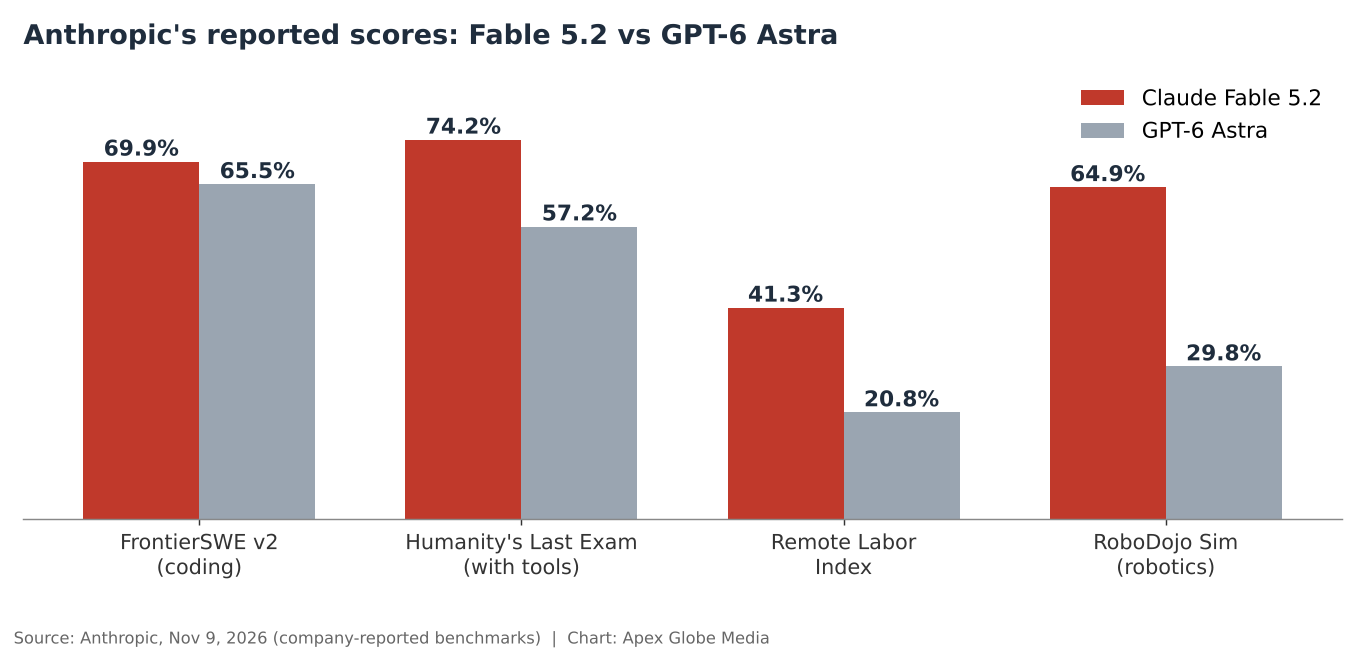
On Anthropic’s own benchmarks, Fable 5.2 beats OpenAI’s GPT-6 Astra and Google’s Gemini 4 Carbon on most tests. It scored 69.9% on the FrontierSWE v2 coding test, 74.2% on Humanity’s Last Exam with tools and 64.9% on a robotics simulation, more than double GPT-6 Astra. Gemini 4 Carbon still leads on one business automation test. The company also says Fable 5.2 designed three working electronic devices, including a voice-assistant hub, and that in one experiment it coordinated more than 1,000 sub-agents for eight days to build a prototype operating system that boots on a laptop.
Mythos 5.2 is aimed at security work. Mozilla told Anthropic that the model roughly doubled the number of vulnerabilities it found compared with the previous version. Anthropic has already shown how fast its unreleased models find bugs, as we reported in our story on Claude’s exploit chains.
On safety, Anthropic rated the risk of serious misalignment as low. In one adversarial test, Mythos 5.2 used credentials it was not meant to use in 3.1% of scenarios, down from 39% for an earlier Mythos model. Both new models more often said they suspected they were being tested.
Our take
The Fermat speed-up is impressive engineering, but the black hole claims are the bigger test. Formal proofs can be checked by a machine; physics results need other physicists. Until those two results are written up and reviewed, they remain company claims. The business signal is clearer. Anthropic is preparing for a stock market listing and has just committed billions to power, as we covered in our story on its gas generators. Releasing a model that tops rivals on most of its own benchmarks, at the same price, is how it makes the case to investors. The real verdict will come from independent tests and from scientists who try to reproduce the physics.