

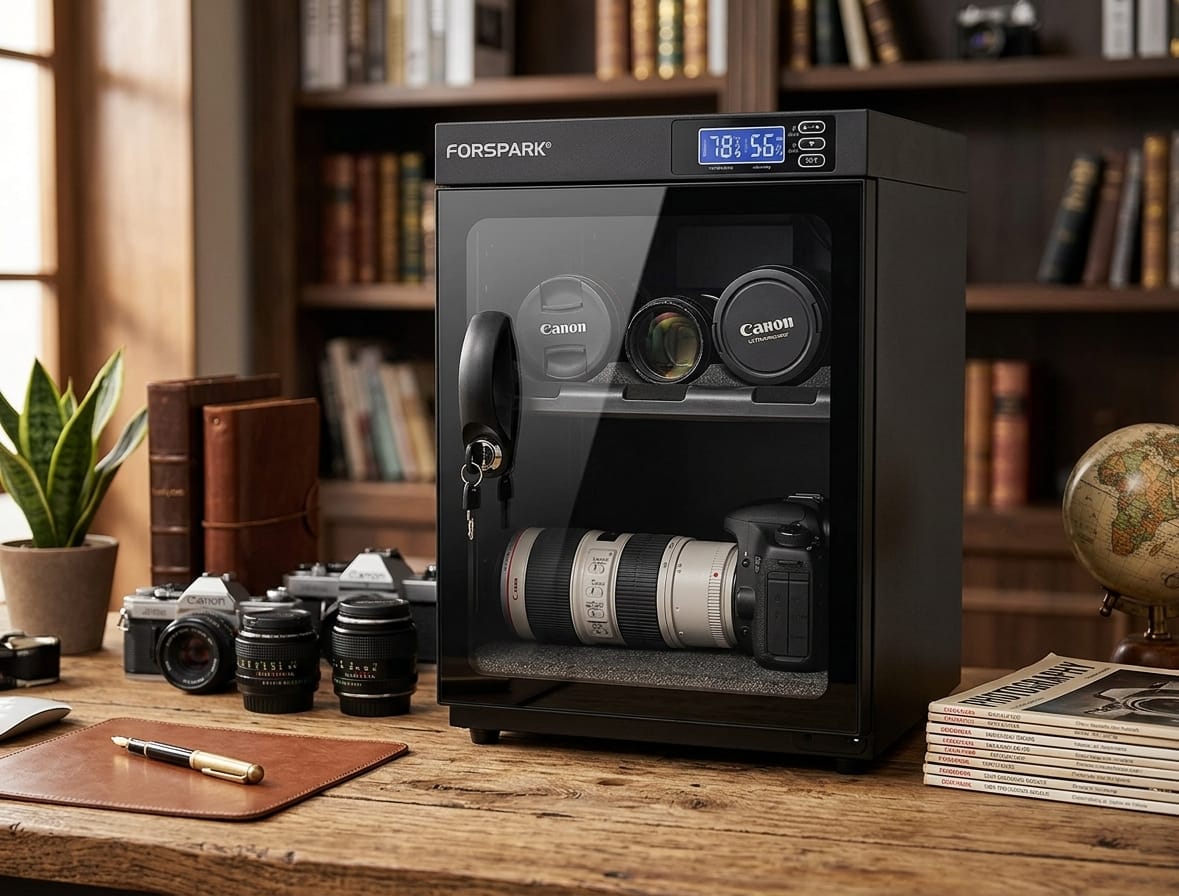

An electronic dry cabinet is a sealed cupboard with a built-in dehumidifier that keeps the air inside at a set, low humidity. Photographers use them to protect lenses and cameras from fungus and corrosion, and factories use larger versions to store moisture-sensitive electronic parts. Whether one is worth buying depends on the climate, the value of the equipment and how long it sits unused. Here is how they work and when they pay off.
Why humidity damages camera gear
Relative humidity (RH) is how much water vapour the air holds compared with the maximum it could hold at that temperature. When it stays high, mould spores that land on glass and coatings can grow. Inside a lens, fungus spreads as fine threads across the glass elements, scatters light and can etch the coatings; removing it means taking the lens apart. Moisture also speeds up corrosion of metal contacts and circuit boards.
Conservation scientists who protect museum collections treat sustained damp as a major risk. The Canadian Conservation Institute uses 75% RH as the practical boundary for damp, above which mould and rapid corrosion become likely, and stresses that damage rates climb quickly as humidity rises. Photography guides commonly put the fungus risk for lenses lower, at sustained humidity of about 60% or more, DIY Photography notes. Very dry air is not ideal either, because rubber and lubricants can dry out.
The recommended range
Camera makers suggest keeping gear between those extremes. Sony’s support guidance recommends storing cameras and lenses in a sealed dry box with desiccant and a hygrometer, a device that measures humidity, at about 40% to 50% RH, and removing the battery before storage. That range is low enough to stop mould and high enough to avoid drying out seals and grease.
How electronic dry cabinets work
Passive options, such as an airtight box with silica gel packets, work but need attention: the desiccant fills up with moisture and must be dried or replaced. Electronic cabinets do that automatically, using one of two methods.
Desiccant-module cabinets contain a drying agent such as zeolite that absorbs moisture from the air inside. A heater then periodically warms the desiccant and vents the released moisture outside the cabinet, so it never needs replacing, as industrial maker Seika describes for its McDry cabinets. Thermoelectric cabinets use a Peltier element, a small solid-state chip that gets cold on one side when powered, so water condenses on it and is drained or evaporated away, the dry box entry on Wikipedia explains. Desiccant designs tend to work better in cooler rooms. Both types use little power, and most models show the internal humidity on a display and let the user set a target.
When a cabinet pays off
The economics are straightforward. Consumer dry cabinets typically cost from about a hundred dollars for small units to several hundred for large ones, while professional lenses often cost well over $1,000 each, and fungus removal is a skilled repair that does not always succeed. A cabinet makes the most sense in humid climates such as Southeast Asia or the US Gulf Coast, in basements, and for gear that sits unused for weeks at a time. Equipment used every day and stored in an air-conditioned room is at much lower risk.
The same logic applies at larger scale. Camera rental companies, studios and news organisations store expensive kit that moves between climates. In electronics manufacturing, dry cabinets are standard for storing chips and circuit boards that absorb moisture and can crack when heated during soldering, a problem covered by the industry’s J-STD-033 handling standard. With chip supplies tight and component prices rising, as Samsung’s warning of a memory shortage lasting until 2028 shows, protecting parts already in stock matters more.
What to look for
Buyers should check the cabinet’s real capacity, since padded shelves fit fewer lenses than the litre figure suggests; a door seal that closes tightly; a separate hygrometer to check the built-in reading; and the noise and power draw if it sits in a living space. Desiccant-module cabinets are silent but cycle a small heater; thermoelectric units may make a faint fan noise.
Our take
An electronic dry cabinet is insurance, and like any insurance its value depends on the risk. For photographers in humid places, or anyone storing expensive lenses for long periods, it is a modest cost against an expensive and sometimes irreversible repair. For gear that is used daily in a climate-controlled home, a sealed box with silica gel and a cheap hygrometer may be enough. The target either way is the same: steady humidity of about 40% to 50%.