

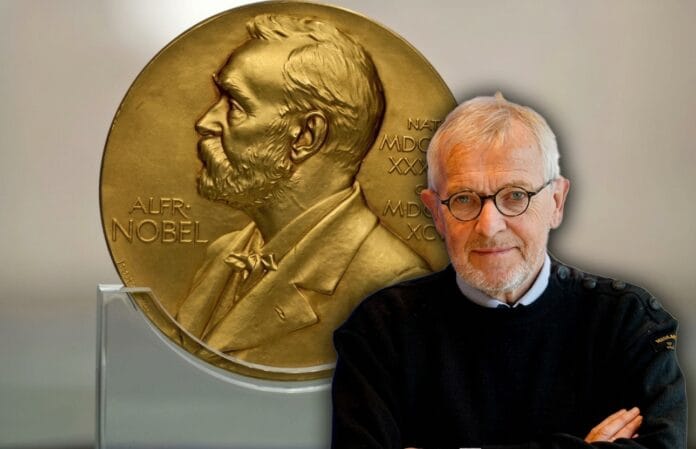

For nearly four decades, one physicist kept a strange idea alive: turn the ice under the South Pole into a detector for particles that almost nothing can stop. On October 6, the Royal Swedish Academy of Sciences gave Francis Halzen the 2026 Nobel Prize in Physics “for decisive contributions to the IceCube Neutrino Observatory and the discovery of high-energy neutrinos of astrophysical origin.”
Who is Francis Halzen?
Halzen is an 82-year-old Belgian-born physicist at the University of Wisconsin–Madison and the principal investigator of IceCube. He is the first person to win the physics prize alone since Georges Charpak in 1992. Halzen told the Nobel press conference by phone from Italy that the news was a great surprise. He admitted that people had predicted his win, but the call still felt strange. Belgium’s prime minister said Halzen is the country’s 11th Nobel laureate.
What are neutrinos, and why are they hard to catch?
Neutrinos are tiny particles that interact so rarely with matter that most of them pass straight through the Earth, and through IceCube, without leaving any trace. That is also what makes them useful. Unlike light, they travel from distant cosmic sources without being blocked or bent, so they carry information that is hard to get any other way, as Nobel committee chair Mark Pearce put it.
The price of this property is size. To catch enough neutrinos, a detector must be enormous, around a cubic kilometre.
How does IceCube work?
IceCube uses the Antarctic ice itself as the detector. It has 5,160 optical sensors on 86 strings, placed between about 1.5 and 2.5 kilometres below the surface. On the rare occasions a neutrino collides with an atom in the ice, the collision produces a faint flash of light, and the sensors record it. By comparing when each sensor saw the flash, scientists work out where the neutrino came from.
Halzen proposed the ice-as-detector idea in 1988 together with a colleague. IceCube’s predecessor, AMANDA, was completed in 2000 but did not find the high-energy neutrinos Halzen was looking for. The answer was to build much bigger.
What did IceCube discover?
In 2013, the team reported evidence for a population of high-energy neutrinos coming from beyond the solar system. They found 28 of them, including two, nicknamed Bert and Ernie, that were the highest-energy neutrinos ever detected.
The next step was finding a source. On September 22, 2017, IceCube detected a neutrino from the direction of a flaring blazar called TXS 0506+056, about four billion light-years away. It was the first time a high-energy neutrino had been linked to a specific cosmic object, and the 2018 papers in Science confirmed it. Later results pointed to the active galaxy NGC 1068 and to neutrinos from the plane of our own Milky Way. The origin of most of the cosmic neutrino flux is still unexplained.
Why this prize matters
Pearce said Halzen’s tenacity and scientific vision has paved the way for a new kind of astronomy. It is the fifth Nobel Prize connected to neutrinos, and the first went to the muon neutrino discovery in 1988.
The lesson links this prize to the one announced the day before. On Monday, the medicine prize went to optogenetics, a method that lets scientists switch nerve cells on and off with light. Both awards honour a new way of observing nature, and both took decades. Halzen’s idea dates to 1988, the first evidence arrived in 2013 and the prize came 13 years after that. As the American Institute of Physics put it, when we find a fundamentally new way to observe nature, we often discover new questions we didn’t know how to ask.
What comes next
The prize is 12 million Swedish kronor, about $1.2 million, and will be presented in Stockholm on December 10. The chemistry prize will be announced on Wednesday.
Nobel Prize in Physics 2026: quick answers
Who won the Nobel Prize in Physics 2026? Francis Halzen, for his contributions to the IceCube Neutrino Observatory and the discovery of high-energy neutrinos of astrophysical origin.
Where is IceCube? At the South Pole, buried in a cubic kilometre of Antarctic ice.
What is a neutrino? A tiny particle that almost never interacts with matter. IceCube detects the rare ones that do.