


SpaceX has found a new way to pay for its AI ambitions without borrowing in the usual sense. In a regulatory filing on October 26, the company disclosed a binding commitment for a roughly $40 billion lease of Nvidia GPUs and related data center equipment from an entity managed by Apollo Global Management. SpaceX calls it the “largest committed GPU financing.” The deal says as much about where AI money now comes from as it does about SpaceX.
How the lease works
According to the filing as reported by TechCrunch and Unite.AI, SpaceX signed the commitment letter on October 24. An Apollo-managed company will buy GPU pods and server hardware and lease them to SpaceX for data centers SpaceX chooses. The equipment arrives in tranches, and each tranche has its own lease of about five to five and a quarter years, starting when it is delivered.
Rent is paid quarterly in advance. Each payment covers one-twentieth of the tranche’s cost, a fixed interest rate on the remaining balance and some running costs. The rate will be set before the master lease is signed and was not disclosed. Goldman Sachs structured the deal, and BlackRock, Goldman Sachs Asset Management and accounts advised by KKR made anchor commitments. Apollo said the money will help deliver Nvidia’s next-generation Vera Rubin chips for SpaceX’s “terrestrial compute buildout.” Closing is expected before the end of 2026, and the first leases would start in the first half of 2027. The filing also warns that the deal may not close on these terms, on time or at all.
Why SpaceX needs it
The numbers from SpaceX’s third quarter explain the urgency. Revenue was $14.6 billion, up 161% from a year earlier, and the segment SpaceX now calls Super Intelligence, which includes the Grok chatbot, the Cursor coding tool and cloud computing, brought in about $7.6 billion of it. That is more than Starlink and rocket launches combined.
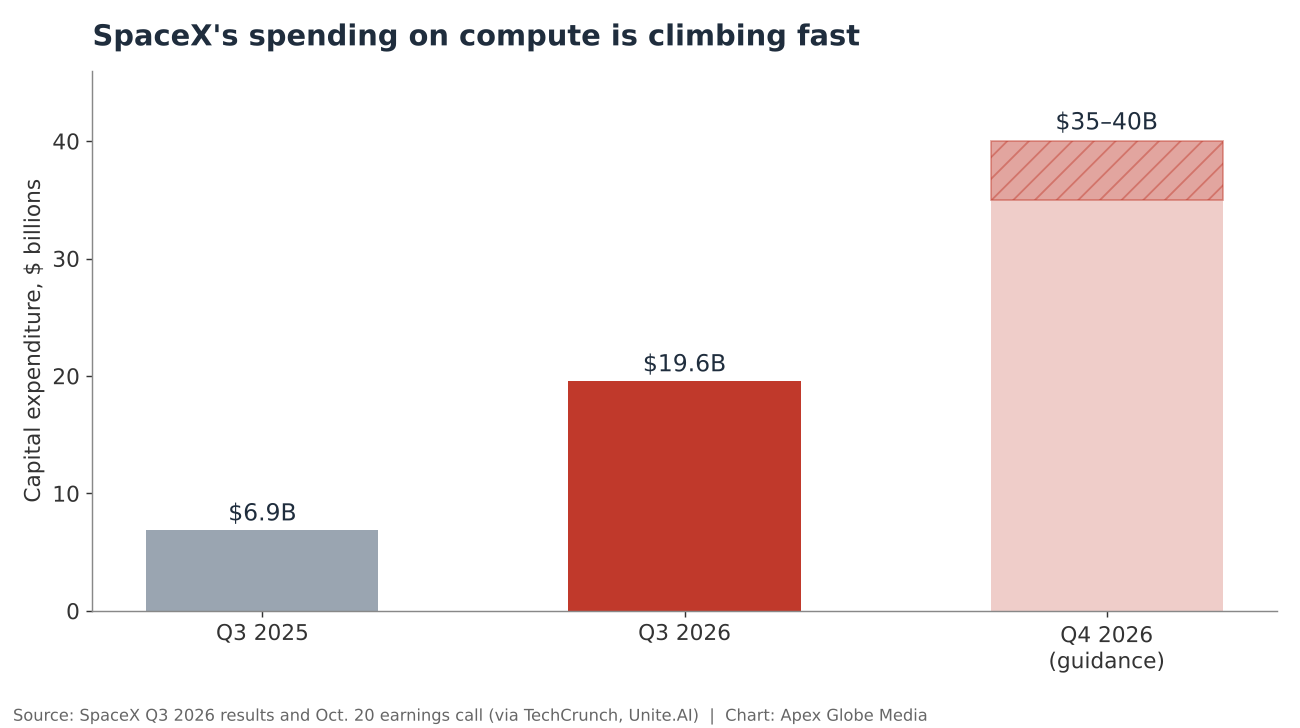
Spending is growing even faster. Capital expenditure, the money spent on long-term assets such as chips and buildings, was $19.6 billion in the quarter, compared with $6.9 billion a year earlier, and $16.4 billion of it went to the AI segment. Over nine months SpaceX spent $48.1 billion. On its October 20 earnings call the company guided for $35 billion to $40 billion in the fourth quarter alone.
At that pace, even a company with Starlink’s cash flow needs outside capital. Chief financial officer Bret Johnsen said the lease “diversifies our funding sources” and covers a notable part of the company’s growth plans. He also said SpaceX sees payback periods of under a year on its AI infrastructure, a claim that cannot be checked from outside.
Private credit moves into chips
The more important story is the structure. Instead of SpaceX issuing bonds and owning the chips, a private credit fund owns them and collects rent. This kind of financing has been building all year. In August, Nvidia signed memorandums with six firms, including Apollo, BlackRock, Blackstone, Brookfield, Goldman Sachs and KKR, aimed at mobilising more than $500 billion of outside money for AI infrastructure.
For SpaceX the appeal is clear: the cost is spread over five years and the chips do not all sit on its own balance sheet as debt. For Apollo and its partners, the bet is that SpaceX will keep paying rent on hardware that may lose much of its value long before the lease ends, because each Nvidia generation makes the previous one less competitive. Part of the technology risk moves from the tech company to the lenders and, through them, to pension funds and insurers.
Elon Musk framed the deal as a sign of strength. In posts on X he pointed to SpaceX’s investment-grade status and argued that debt markets have largely closed to companies without major revenue outside AI data centers. He predicted “guppy-level death and consolidation” among the more than 200 smaller “neocloud” firms that rent out GPUs. That is a competitor’s forecast, not a neutral one, but it matches the tougher mood in AI debt markets that TechCrunch describes.
The lease also adds to the pile of obligations investors will weigh if SpaceX pursues the merger talks with Tesla we covered on October 24. And it lands the same week Anthropic opened its books for an IPO showing compute as its largest single cost.
Our take
The $40 billion headline is less remarkable than who is supplying it. When a rocket company finances AI chips through a private credit fund backed by the biggest names in asset management, the AI buildout is no longer paid for mainly by tech companies’ own cash. That spreads the risk more widely, and it means a slowdown in AI demand would not stay inside Silicon Valley. The lease is a sensible move for SpaceX; whether it is a sensible one for the lenders depends on how long Vera Rubin chips stay worth renting.