

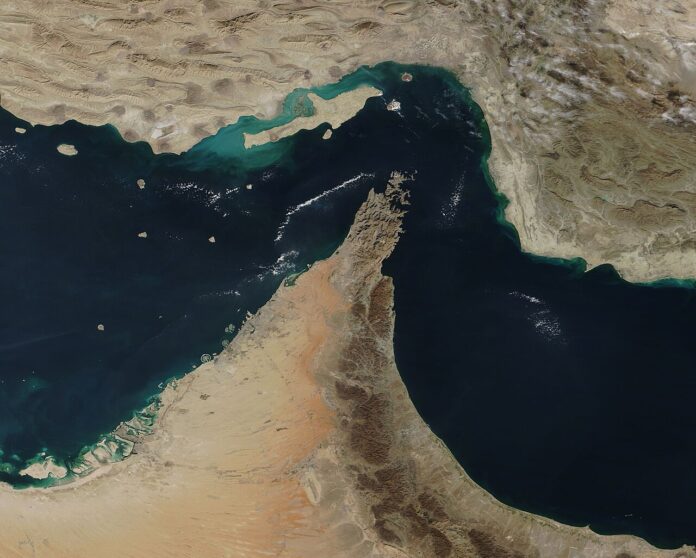

Iran is no longer only threatening oil tankers in the Strait of Hormuz. Two senior Iranian security officials told Reuters that Tehran has drawn up detailed plans to attack undersea internet cables in the Gulf if the United States and Israel strike Iran again, and that it would try to block repairs to make the outages last. For the rest of the world the direct effect would be small. For Gulf states that are spending billions to become AI and data center hubs, it is a direct threat to that plan.
What Iran has said
The Reuters report, republished on October 26, quotes one official saying Iran has “full access to the undersea cables” and that “if Iran is attacked, there will be no more red lines … from undersea cables to military bases, including covert ones.” The second said Gulf states “should hold Washington, not Tehran, responsible” for any damage. Neither said how or where an attack would happen.
The report follows a run of public warnings. On October 19, Revolutionary Guards spokesman Hossein Mohebbi said seven major internet cables run beneath the Strait of Hormuz, and on October 21 the Guards’ political deputy Yadollah Javani said they could be targeted if Iranian infrastructure is attacked, Iran International reported. Earlier in October, senior security official Mohsen Rezaei warned that U.S.-linked data centers and AI facilities in the Gulf could also be hit. These are not empty categories: according to Reuters, Iranian strikes hit two Amazon Web Services facilities in the UAE in March and damaged infrastructure near one in Bahrain, and the Guards named Microsoft, Google, Apple and Nvidia as legitimate targets during that war.
The timing matters. NPR reported on October 22, citing a person briefed on the planning, that the U.S. and Israel are preparing options for a possible strike on Iran in early November, after the midterm elections.
Which cables, and who depends on them
An analysis by maritime intelligence firm Windward, based on TeleGeography data, counts six live cables crossing the strait: 2Africa, AAE-1, FALCON, Gulf Bridge International, Tata TGN-Gulf and OMRAN/EPEG. Two more, FIG and SEA-ME-WE 6, are due in 2027. Their owners include Meta, Orange, Vodafone, China Mobile and the main Gulf telecom operators.
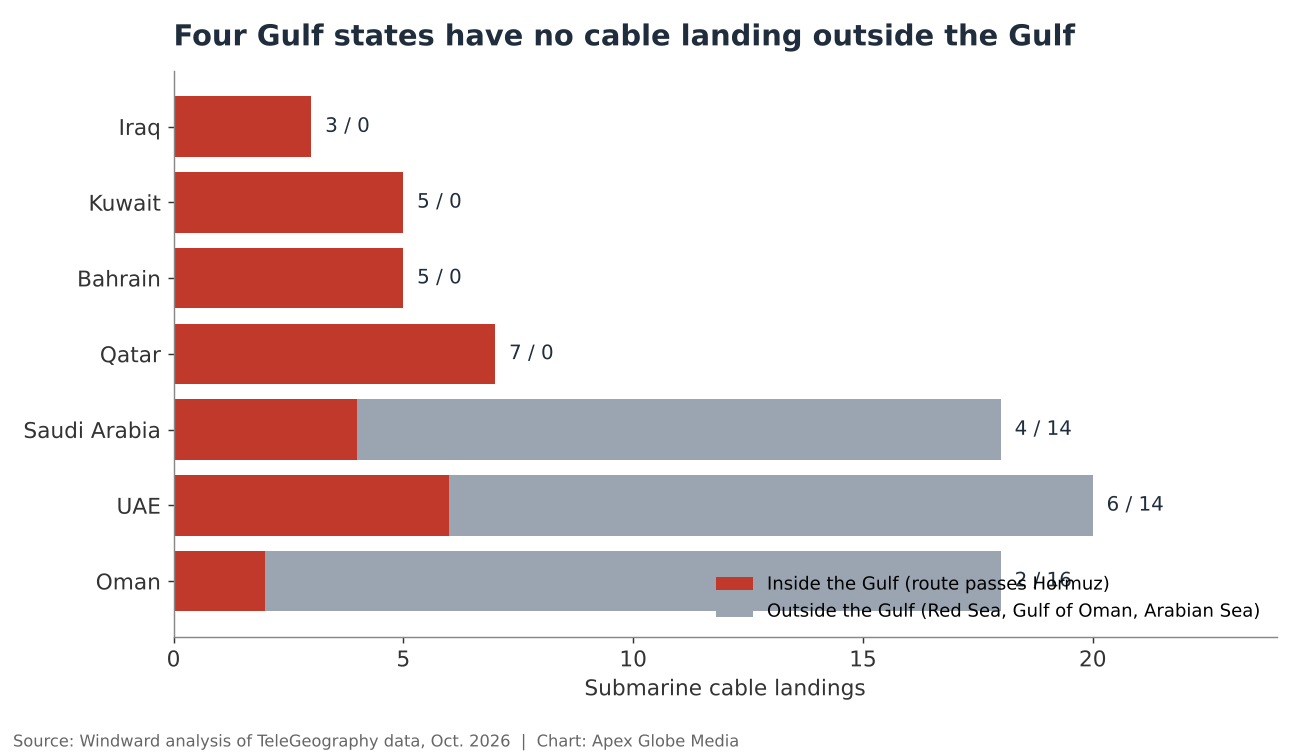
Exposure varies widely by country. Iraq, Kuwait, Bahrain and Qatar have no cable landings outside the Gulf, so every subsea route they use passes Hormuz. The UAE, Oman and Saudi Arabia are better placed: the UAE has 14 landings at Fujairah and Kalba on the Gulf of Oman, and most of Saudi Arabia’s international capacity lands on its Red Sea coast.
Globally, the stakes are lower than the rhetoric suggests. Alan Mauldin of TeleGeography told Reuters that less than 1% of international bandwidth passes through the strait. The main data routes between Europe and Asia run through the Red Sea, not Hormuz. Analysts quoted by Reuters said the Red Sea, where Iran’s Houthi allies operate, would be a more damaging target, although Tehran has made no threat there.
Signs at sea
Windward also flagged two sanctioned, Iran-linked tankers that drifted for long periods over cable routes in the two weeks before Mohebbi’s speech. One, sanctioned in 2024 for moving cargo for the Guards’ Quds Force, changed its identifiers four days before drifting for 73 hours near the AAE-1 and 2Africa corridors off Oman. The other loitered for 115 hours in the Arabian Sea over five cable routes. Windward stresses that neither drift is a confirmed survey, and this is a commercial firm’s reading of tracking data, not an official finding.
There is a built-in limit to the threat. FALCON, GBI and OMRAN/EPEG also land in Iran, so cutting them would hurt Iran’s own connections. The cables that do not touch Iran, such as 2Africa and the future FIG and SEA-ME-WE 6, are the more likely targets if Tehran wants to hit its neighbours without cutting itself off.
What an outage would mean
Cable damage is not new to the region. In February 2024 three Red Sea cables were cut, most likely by the dragging anchor of the Houthi-damaged ship Rubymar, and repairs took about six months. Operators can reroute some traffic within hours, but a deliberate campaign that blocks repair ships would be different. Insurance costs and permits to enter territorial waters already slow repairs in peacetime.
The bigger cost would fall on the Gulf’s technology strategy. The UAE and Saudi Arabia are building AI campuses with U.S. partners, and Microsoft alone plans to invest more than $400 million in subsea and land connectivity in the Middle East by 2030. Alex Vatanka of the Middle East Institute told Reuters the threats are meant to make Gulf governments and U.S. companies fear for those investments. We looked at another case of connectivity becoming a lever in war in our report on Starlink in Ukraine.
Our take
The global internet would barely notice a cut at Hormuz, but Kuwait, Bahrain and Qatar would, and so would every company that put a data center in the Gulf on the assumption that it was a safe place to put one. That is exactly the leverage Iran is looking for. Expect the response to come from engineers as much as diplomats: more land routes through Saudi Arabia and Iraq, more cables that avoid the strait, and harder questions from investors about where AI infrastructure in the region should be built.