

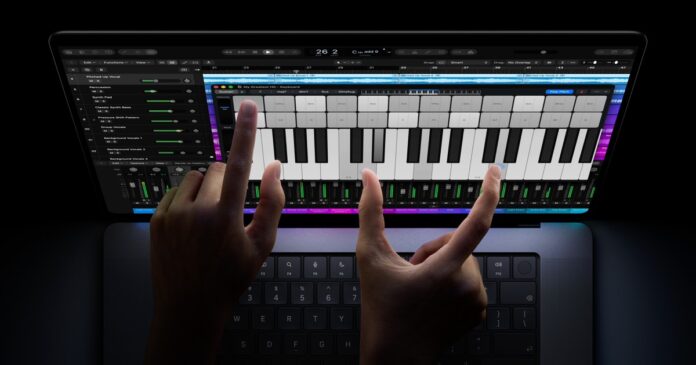

Apple has made the laptop it spent sixteen years saying it would not make. The touchscreen MacBook Pro with a PROLED XDR display, announced on October 28, is the first Mac you can control with your fingers, and it arrives with an OLED panel, a Dynamic Island borrowed from the iPhone and the highest starting price ever for a MacBook Pro: $2,899 for the 14-inch model.
What Apple announced
According to Apple’s press release, the 14-inch and 16-inch models use a tandem OLED panel, in which two layers of light-emitting material are stacked to raise brightness and extend lifespan. Apple quotes up to 2,000 nits of brightness for both HDR and standard content, a 10,000,000:1 contrast ratio and a refresh rate that varies from 10Hz to 120Hz. Johny Srouji, Apple’s chief hardware officer, called it “the world’s best laptop display.”
The touch sensor is built into the panel itself rather than layered on top, which Apple says reduces latency. Users can scroll, pinch to zoom, drag files between windows, flick windows to tile them and draw across the whole screen. Older apps work because macOS converts touches into clicks, and Apple says developers including Microsoft, Adobe, Zoom, Canva and Blender are adapting their software, some of it later this year. The hinge has been redesigned so the screen does not wobble when tapped.
The machines are also lighter. The 14-inch model weighs 3 pounds, half a pound less than before, and the 16-inch weighs 4 pounds. Apple claims up to 24 hours of battery life. Pre-orders opened on October 28 in 30 countries, with deliveries from November 6.
The price, and an odd chip choice
Touch comes at a steep premium. The 14-inch model with an M5 Pro chip starts at $2,899, the 16-inch at $3,399, and the M5 Max versions at $4,499 and $4,799. Engadget calls it the highest launch price it has seen for a MacBook Pro and notes that a fully loaded 16-inch model with 128GB of memory and 16TB of storage costs $14,549.
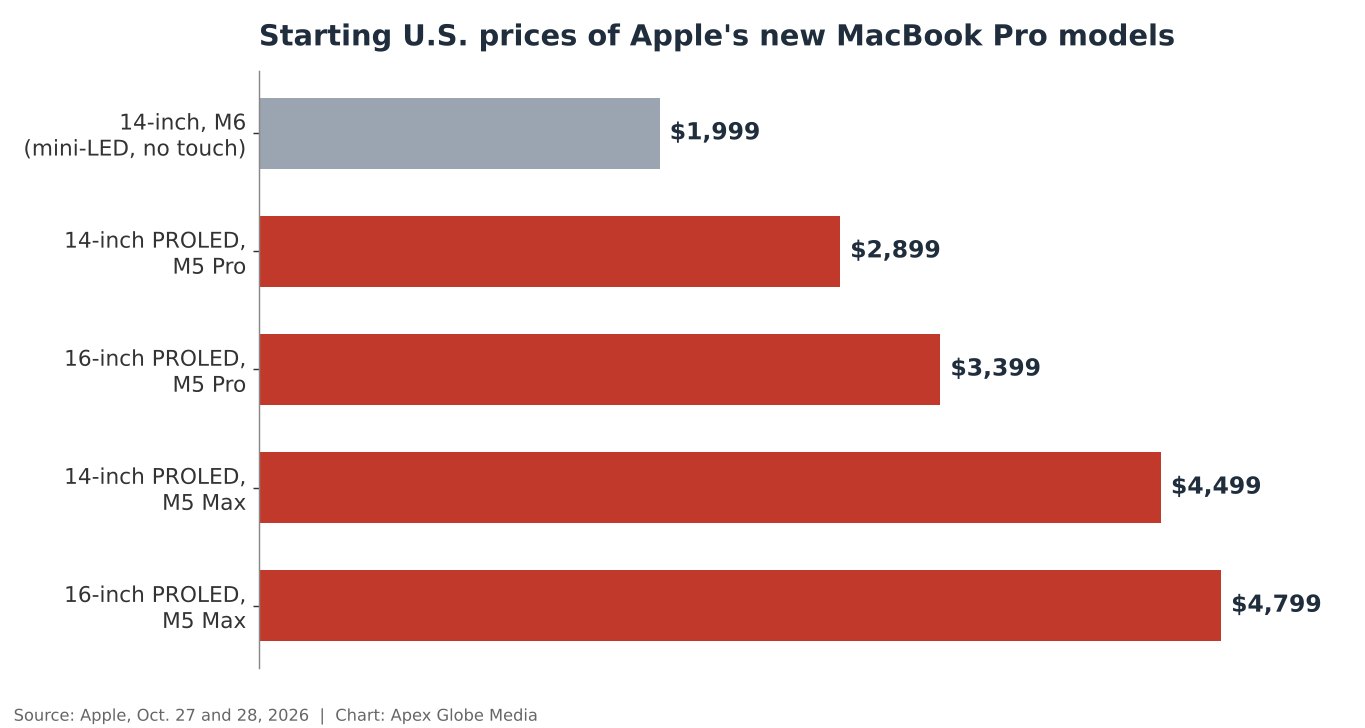
The chip lineup is the strangest part. As MacRumors points out, the touchscreen models use the same M5 Pro and M5 Max chips Apple introduced in March, while the cheaper 14-inch MacBook Pro announced just a day earlier has the newer M6, built on a 2-nanometre process, with a conventional mini-LED screen. Apple has not explained the split. In practice, buyers now have to choose between the newest base chip and the new display; for now they cannot have both in one machine. We looked at the M6 models in our report on Apple’s bet on running AI on the desk.
The Pro and Max chips still have more cores and far more memory, which matters for one group Apple is courting: people who run large AI models locally. Apple says the M5 Max can run language models with hundreds of billions of parameters on the laptop itself, and Engadget suggests demand from that crowd may justify the top configurations.
Why Apple changed its mind
In 2010, Steve Jobs dismissed touchscreen laptops on stage. Apple had done “tons of user testing,” he said, and “touch surfaces don’t want to be vertical”: after a while, your arm wants to fall off. For years Apple’s answer to anyone who wanted touch was the iPad.
Several things have changed since. Windows laptops have had touchscreens for about fifteen years, so the feature’s uses are well understood. A generation of users now reaches for any screen with a finger. And the Mac now shares more with the iPhone and iPad, from Apple’s own chips to apps that run on all three. Apple’s design still hedges: the trackpad and keyboard remain the main way to use the machine, and touch is pitched for quick actions such as scrolling, zooming, drawing and playing on-screen instruments rather than all-day tapping.
The Dynamic Island, a pill-shaped area around the camera, hosts Spotlight search, live notifications and Siri AI. Apple notes that Siri AI’s server-side features have daily usage limits, a reminder that the company’s cloud AI is still rationed.
Our take
Adding touch to the Mac is overdue, and Apple’s version, built into an excellent-sounding OLED panel with a hinge designed for it, is likely to be among the best on any laptop. But the launch is confusing. A $2,899 machine with last generation’s chip sits beside a $1,999 one with the new chip, and the most interesting display Apple has made is reserved for buyers spending close to $3,000. Most people should wait for independent reviews of battery life and of how much touch really adds in macOS, and for the day when OLED and touch reach the M6 models.