


Two days before the U.S. midterm elections on November 3, a run of studies shows that AI chatbots are giving voters wrong deadlines, mixing up candidates, repeating foreign propaganda such as a fake claim about Texas Senate candidate James Talarico and citing political ads disguised as local news. This is the first federal election in which millions of Americans are asking chatbots for election information, and researchers say the tools are shaping what voters see in ways nobody fully controls.
Wrong deadlines and mixed-up candidates
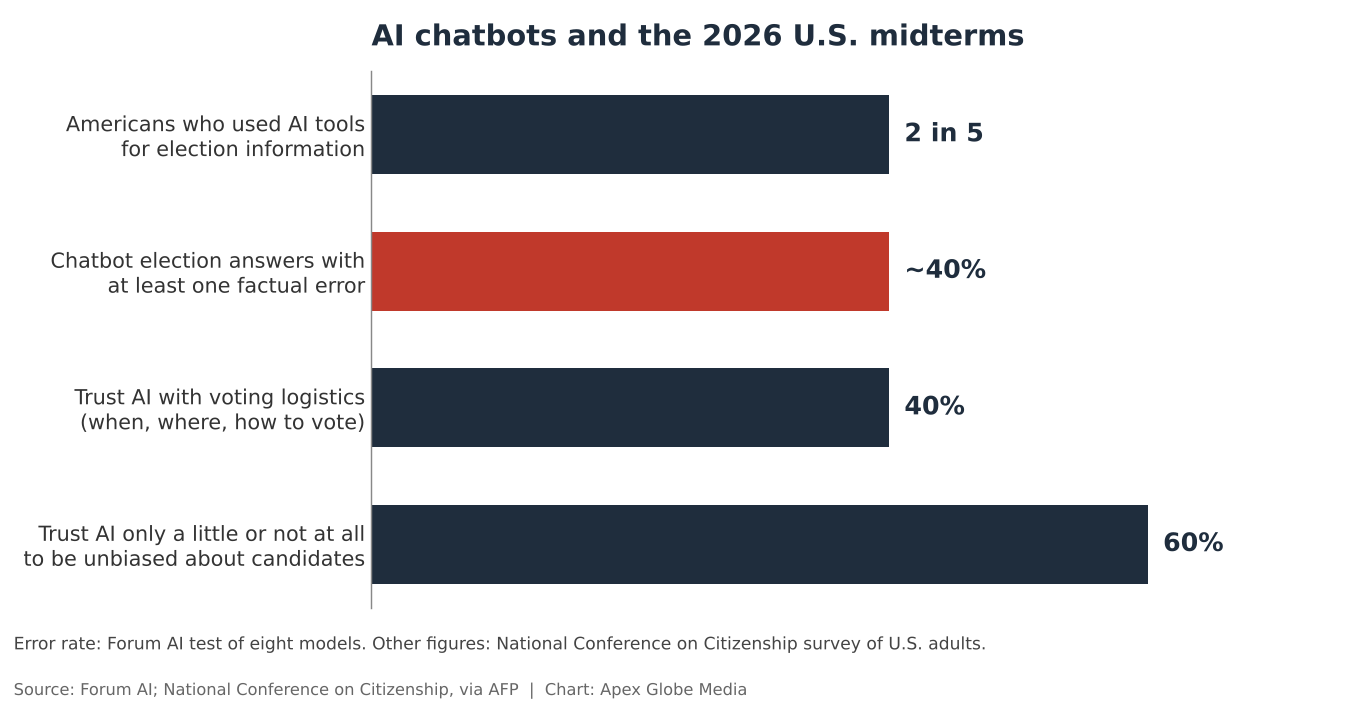
The most detailed test comes from Forum AI, a startup that evaluates AI models. It examined eight models and found that almost 40% of their answers to election questions contained at least one factual error, AFP reported. Asked why voters should re-elect North Carolina Representative Don Davis, Anthropic’s Claude listed “former school superintendent” among his credentials, confusing him with someone else. Google’s Gemini 3.6 Flash told a user in Pennsylvania that the deadline to request a mail-in ballot was November 3; it was a week earlier. “A voter who followed the answer would have asked for a ballot too late to use it,” the study said.
Errors were more common on practical questions about how to vote than on questions about candidates, which is the opposite of what many people would expect. Forum AI also found that chatbots “put the wrong words in the mouths of candidates, officials, and observers hundreds of times” and often relied on weak sources such as Reddit threads.
How Google and Microsoft AI tools repeated a fake claim about Talarico
Chatbots can also amplify deliberate deception. In mid-October, two videos appeared that supposedly showed a former student of James Talarico, the Democratic Senate candidate in Texas, accusing him of sexual abuse when Talarico taught sixth grade in San Antonio. The disinformation watchdog NewsGuard found that the man in the videos is an AI deepfake and that they were produced by Storm-1516, a Russian influence operation. The real former student told the fact-checker Lead Stories: “It’s not me. The video is very much AI, very bad AI.” Talarico’s campaign called the claim “totally baseless and false,” according to NewsGuard’s midterms briefing of October 26.
When NewsGuard tested the claim, Google’s AI Overview stated as fact that the supposed student “published a video claiming that James Talarico sexually assaulted him in 2012,” and Google’s Gemini and Microsoft’s Copilot also repeated the accusation. Neither tool flagged that the video was fake. Asked about it later by AFP, Google said the issue “was addressed as our systems quickly updated to surface the latest reporting on this topic,” and Microsoft said it was “a rapidly developing situation with limited reliable information available at the time of the initial query.” The case shows the weak spot: in the first hours after a fake goes viral, there is little reliable reporting for an AI tool to draw on, and the fake itself is the most “relevant” source it can find.
Fake local news sites built for chatbots
A separate investigation by NPR found that ChatGPT cited websites posing as local news outlets that are in fact political promotion. Asked which House candidates in Michigan’s 4th District care about affordability, ChatGPT put Democrat Sean McCann at the top, citing the “Kalamazoo Beacon,” a site that had published only 16 stories, all about McCann. It is one of 37 sites identified by the security firm VisionHeight, most promoting Democrats, all set up on September 15 and almost all registered within eight minutes. Their operator is unknown, and the Democratic Congressional Campaign Committee denied involvement. Google’s products avoided promoting the sites, NPR found.
The sites were built for machines. They explicitly allow AI companies’ crawlers to scrape them, and many articles are written in question-and-answer format, which chatbots like to cite. Many real news outlets, by contrast, block those crawlers, a choice that will become easier with the new shared opt-out signal backed by the largest AI companies. The result is a perverse incentive: credible journalism hides from AI, while political content made to look like journalism invites it in.
Voters are using AI anyway
In a survey by the nonpartisan National Conference on Citizenship, two in five Americans said they had used AI tools to look up election information such as candidates or ballot measures. Only 40% said they trust the tools on voting logistics, and 60% said they trust them “only a little or not at all” to be unbiased about candidates. The Institute for Strategic Dialogue calls this the first U.S. election with AI tools built into every major tech platform.
The picture is not all negative. Research by the Brennan Center for Justice found that leading chatbots pushed back against common conspiracy theories, such as rigged voting machines, even when users kept pressing, and that they “could play a constructive role in fighting election disinformation.” AI companies have also added election safeguards, such as ChatGPT turning election deepfakes into cartoons, but the tests show those safeguards miss a lot.
Our take
The safest advice for voters this week is simple: use chatbots to understand issues if you like, but check deadlines, polling places and rules with your state or county election office. The bigger lesson is for AI companies. A chatbot that cites a fake local news site with the same confidence as a real newspaper turns search engine optimisation into a new form of political advertising, without the disclosure rules that apply to ads. Before the 2028 presidential election, AI firms need clear source-quality standards for election answers and public reporting on what their models get wrong, not just promises that their systems “quickly updated.”