


Mercedes-Benz has stopped committing new money to its factories in Germany and says it may have to close some of them. “The executive board has jointly decided to halt all further investments in German sites,” production chief Michael Schiebe said in an interview posted on the company intranet on Thursday, November 12, and shared with AFP. “We are now forced to carefully examine which German sites we would have to close.”
The move is a pressure tactic in stalled talks with workers over labour costs. It is also a striking moment for German industry: Mercedes was founded in Germany, still employs about 108,000 people there, two-thirds of its global workforce, and runs 11 German plants, some of them more than 100 years old, according to The Telegraph.
What is frozen, and what is not
Mercedes is not leaving Germany overnight. The company told Automotive Manufacturing Solutions that projects already under way continue. The freeze covers future vehicle programmes and production investments planned for the coming years. A new paint shop in Sindelfingen, a billion-euro project, will go ahead as planned.
The bigger threat is about where future models are built. Money earmarked for German sites could move to other locations if no cost deal is reached, the company said. Mercedes also confirmed that closing one vehicle assembly plant and one powertrain plant in Germany remains possible. It did not say which. Its German car assembly happens in Sindelfingen, Rastatt and Bremen, while engines, electric drives and components come from sites including Stuttgart-Untertürkheim, Berlin and Hamburg.
Labour director Britta Seeger said: “We all want to avoid plant closures at all costs. Unfortunately, however, we must now explore this option in more detail.” She added that “no solution is currently in sight.”
Why Mercedes says Germany costs too much
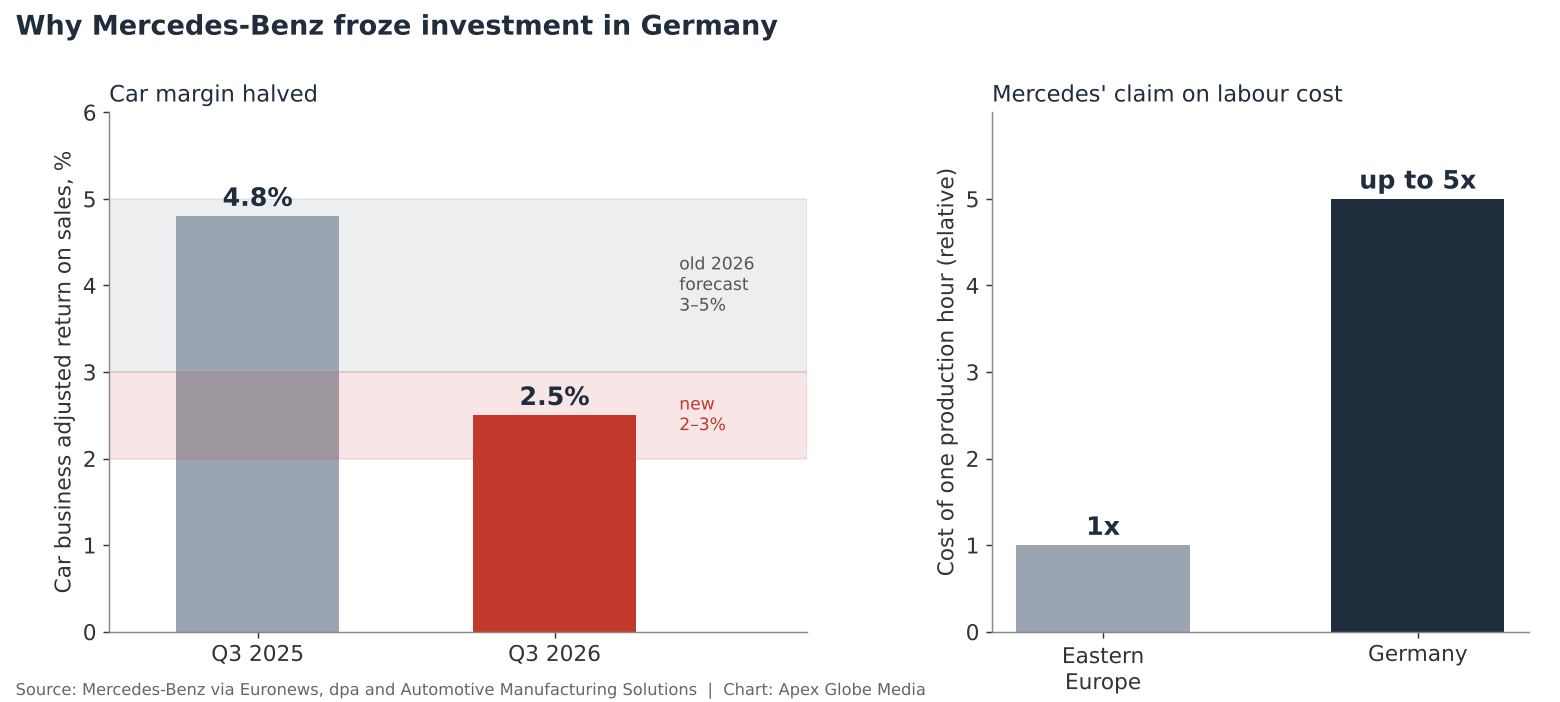
Mercedes says one production hour in Germany can cost up to five times as much as at its plants in Eastern Europe. Its factory in Kecskemét, Hungary, became its largest plant this year, according to The Telegraph. The company wants to save about €800 million, and German media report that the plan could include raising the working week from 35 to at least 38 hours, without extra pay, and cutting holiday bonuses.
The financial pressure is real. On October 27, Mercedes cut its 2026 margin forecast for its car business to an adjusted 2% to 3% of sales, down from 3% to 5%, blaming a “more challenging market environment in China” and higher costs, Euronews reported. The car margin in the third quarter fell to 2.5%, from 4.8% a year earlier, and car sales dropped 8%, with buyers in China switching to cheaper local brands.
Workers promise a fight
Employee representatives reacted sharply. “Threatening plant closures is no way to shape the future,” a works council representative said, adding: “Anyone who resorts to such threats must expect our determined resistance.” Ergun Lümali, who chairs the general works council, rejected closures outright. Barbara Resch, regional director of the IG Metall union, criticised the company for freezing investment while asking staff to work longer and give up benefits, and called for a commitment to new models in Germany.
Mercedes is not alone. Volkswagen doubled its planned job cuts to 100,000 in September and is weighing the future of four German plants, and BMW said last week it will cut 8,000 jobs after an 11% fall in quarterly pre-tax profit, The Telegraph reported. Mercedes was the third big German carmaker to cut its annual outlook this autumn.
A test for German engineering
For the technology side of the car industry, the stakes go beyond wages. Germany’s plants are where Mercedes has built its newest production systems, including the digital “Factory 56” in Sindelfingen. If future model lines move east, the engineering jobs that launch new cars and electric drivetrains can follow. The pressure also comes from technology: Chinese carmakers have won buyers with cheaper electric cars packed with software, the same buyers Mercedes is now losing. Rivals are reshaping their own factories just as quickly: last week Tesla said it would end Cybertruck production in Texas to build more robotaxis.
Our take
Freezing investment is a negotiating weapon, and Mercedes is using it openly: the paint shop keeps going, no plant is named, and management still says it hopes for a deal. But the numbers behind the threat are not invented. A 2.5% car margin is thin for a luxury brand, and a fivefold labour cost gap is hard to bridge with longer hours alone. The likely outcome is a painful compromise rather than closures. The real risk for Germany is quieter: each new model that gets assigned to Hungary instead of Sindelfingen moves a little more of the country’s car know-how out with it.