



Starship Flight 15 made history on Saturday. After a day in orbit, SpaceX’s Ship 42 came back to Starbase, Texas, and was caught by the mechanical arms of its launch tower at about 3:20 p.m. Central time (1:20 p.m. in Los Angeles), CNBC reported. It is the first time the upper stage of an orbital rocket has returned from orbit to an upright landing at its launch site, CNN noted in its live coverage. The win came a day after the other half of the plan failed: the Super Heavy booster, known as Booster 22, called off its own tower catch on Friday, diverted to the Gulf of Mexico and broke apart before it reached the water, Spaceflight Now reported.
What happened on Friday
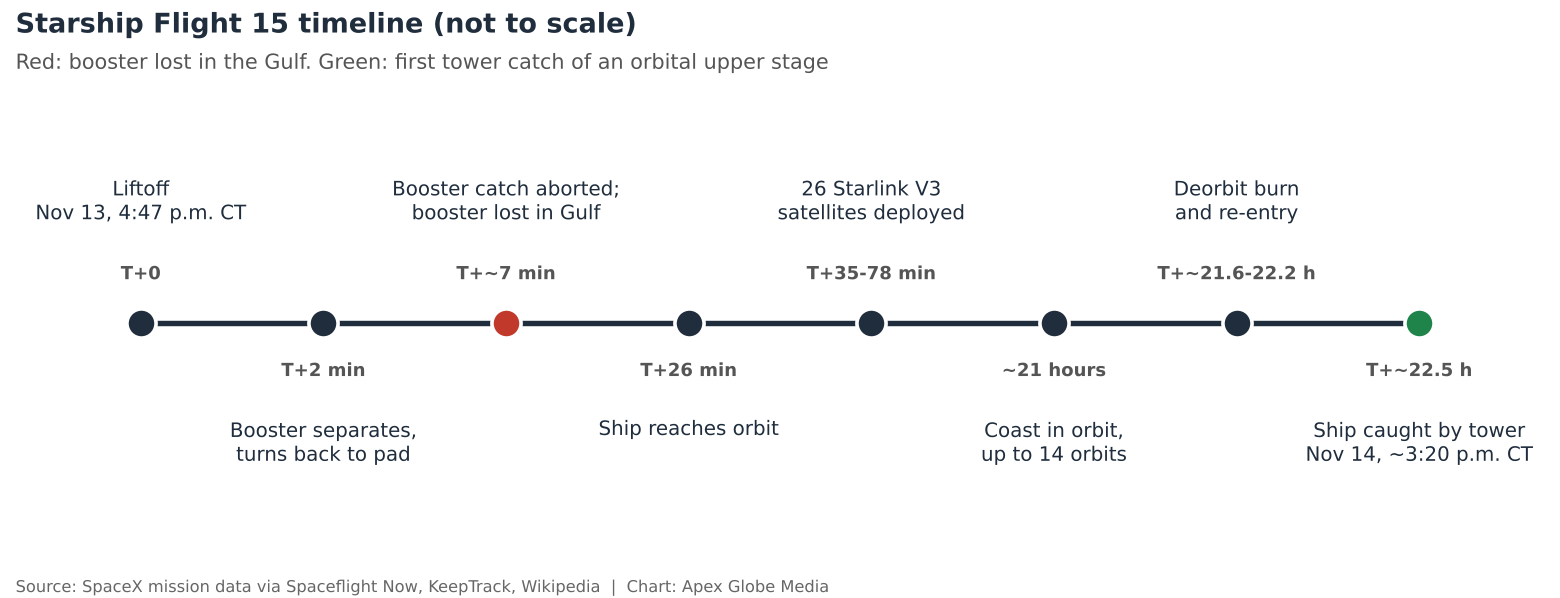
Starship lifted off from Starbase, Texas, at 4:47 p.m. Central time on November 13 (2:47 p.m. in Los Angeles). It was the 15th flight of the rocket and the fourth for the larger Block 3 version. The Federal Aviation Administration issued the launch license the same day, including approval for the ship to fly back over populated areas on its way home.
About two and a half minutes after launch, the booster separated and turned back toward the pad. Since October 2024, SpaceX has caught several Super Heavy boosters in mid-air with two giant mechanical arms on the launch tower, nicknamed “chopsticks.” This time the catch never happened. According to Spaceflight Now, the booster’s guidance software triggered an automatic abort after finding that the booster was not where it needed to be. Controllers sent it to a backup splashdown point offshore, where it was destroyed shortly before hitting the water. Residents reported loud sonic booms.
The cause is still unclear. SpaceX’s commentators first pointed to the guidance, navigation and control system. About 16 hours into the mission, SpaceX’s Dan Huot corrected that: “It was not a GNC issue that caused us not to come back.” The company has not given another explanation, and CBS News described it only as a “technical issue.”
A day in orbit
The upper stage had a cleaner day. Ship 42 reached orbit and deployed all 26 Starlink V3 satellites, the larger, faster version of SpaceX’s internet satellites, about 40 minutes into the flight, KeepTrack reported. Three of them carry cameras to photograph the ship’s heat shield, the tiles that protect it from the heat of re-entry. Those pictures feed SpaceX’s go or no-go decision for the return.
The ship then coasted for about 21 hours, up to 14 orbits, passing checks that kept the early-return options near Hawaii and Chile in reserve. It then fired its engines to leave orbit, re-entered over the Pacific and glided toward Texas, steering around populated areas in northern Mexico and southern Texas, before the tower caught it about 22.5 hours after launch.
Why the catch matters
Rockets are expensive mostly because they are thrown away. SpaceX made boosters reusable with Falcon 9, which lands on its legs. Starship is supposed to go further: both stages come back to the launch site, get caught by the tower and fly again quickly, without ever touching the ground or the ocean. That is the basis for SpaceX’s plans to launch its next-generation Starlink satellites in large numbers, and for the Starship lunar lander NASA has chosen for its Artemis Moon missions.
Catching a booster has become almost routine. Catching the ship is much harder. The ship has to survive re-entry at orbital speed, roughly 27,000 kilometers an hour, with its heat shield intact, then flip from a belly-first glide to an upright engine burn and arrive within reach of the arms. Elon Musk called a double catch a “profound technology milestone” and put the chances of catching the ship at “more likely than not,” Teslarati reported.
The previous flight shows how fragile the schedule is. On Flight 14, the booster also ended up in the Gulf, and Ship 41 reached orbit even though one engine shut down early. It deployed its 26 Starlink satellites and then splashed down in the Pacific after a shortened coast.
What the catch means
The ship had to pass three tests on Saturday: its heat shield had to survive re-entry at orbital speed, its engines had to relight for the deorbit and landing burns, and the arms had to close on a vehicle coming back from orbit. It passed all three. SpaceX has now caught Super Heavy boosters several times and, for the first time, an orbital upper stage. What it has not yet done is both on the same flight, which is what “full reusability” means in practice. With Booster 22 lost, Flight 15 was a half success: a historic one, but still a half.
Next, engineers will inspect Ship 42 to see how much work it needs before it could fly again. That turnaround, more than the catch itself, will show whether a Starship can be reused the way an airliner is, which is the whole point of the design. SpaceX is also still investigating why the booster aborted.
Cheap launches matter well beyond SpaceX. In October we wrote about how Google put its first AI data center satellite in orbit, one of several plans that depend on launch costs falling the way Starship promises.
Our take
Catching a ship that has just come back from orbit is a genuine first in spaceflight, and it matters more than the lost booster. Boosters have been caught before; an upper stage that survives re-entry and lands at the pad is the piece that was missing for a fully reusable rocket. But Flight 15 also shows how far SpaceX still is from routine: the booster, the part it had already mastered, failed this time, and the company still has not explained why. Until SpaceX recovers both stages on the same flight and flies them again quickly, full reusability remains a promise. Saturday made that promise much more believable.