

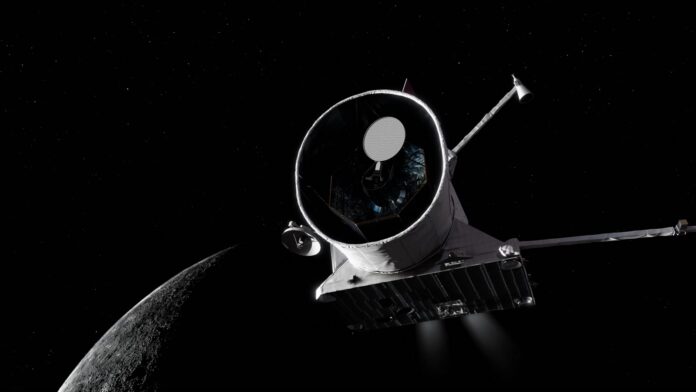

After eight years and nine planetary flybys, BepiColombo is in orbit around Mercury. The joint mission of the European Space Agency (ESA) and the Japan Aerospace Exploration Agency (JAXA) was captured by the planet’s gravity on Saturday, November 21, Eos reported, making it only the second spacecraft ever to orbit the smallest planet, and the first to bring two orbiters there at once. “We’ve heard back from Bepi,” ESA’s operations team posted on Bluesky. “Flight Dynamics already has confirmed it achieved orbital capture around Mercury!”
The capture happened at a planned 19:24 CET, according to ESA’s operations account as quoted by EarthSky. Teams at ESA’s European Space Operations Centre in Darmstadt, Germany, were still going through the telemetry on Sunday and promised a fuller update early next week.
Why Mercury is harder to reach than Pluto
Mercury is the closest planet to the Sun, which sounds like it should make it easy to get to. It is the opposite. A spacecraft falling toward the Sun picks up speed, so the hard part is slowing down enough to be caught by a small planet instead of shooting past it. “Reaching Mercury is actually harder than reaching Pluto,” Azul Pinochet-Barros of ESA’s operations centre said during a September livestream. “The challenge isn’t getting closer to the Sun. It’s losing enough energy to match Mercury’s path around the Sun.”
That is why BepiColombo, launched from Kourou in French Guiana on October 20, 2018, took the long way. It flew past Earth once, Venus twice and Mercury six times, using each pass to shed speed. A thruster problem found in 2024 meant its electric engines could not run at full power, and the arrival slipped from December 2025 to November 2026.
On September 3 the spacecraft dropped its Mercury Transfer Module, the electric propulsion stage that had pushed it across the inner Solar System. Since then ESA’s Mercury Planetary Orbiter (MPO) has been flying the stack on its own chemical thrusters. For the capture, four of those thrusters fired to slow the craft as it approached Mercury’s south pole from the planet’s night side, placing it in an initial, stretched-out orbit of about 590 by 11,640 kilometres, according to ESA’s description of the manoeuvre. ESA used a technique called weak stability boundary capture, which lets a planet’s gravity gently take hold of a slow-moving spacecraft, French partner lab LIRA explained ahead of arrival.
Two spacecraft, two jobs
BepiColombo is really two science missions travelling as one. ESA’s MPO will map Mercury’s heavily cratered surface: its spectrometers will chart what the rocks are made of and how hot they get, a laser altimeter will measure the height of the terrain, and a radio experiment will help work out the size of the planet’s core. It will also scan the poles for ice and look for anything that has changed since NASA’s MESSENGER orbited Mercury from 2011 to 2015.
JAXA’s Mercury Magnetospheric Orbiter, called Mio, will study Mercury’s magnetic field and the space around it. Mercury is the only rocky planet besides Earth with a global magnetic field, and scientists still do not understand what keeps it going or why it is offset from the planet’s centre. Mio will also watch how the field reacts to the Sun, which hits Mercury with a much denser solar wind than reaches Earth.
The instruments have already been checked. In September, ESA switched on all of MPO’s instruments together for the first time since the transfer module came off. The laser altimeter BELA fired more than 700,000 pulses into open space over 21.5 hours, its first full test since 2016 on the ground, and the SIMBIO-SYS camera took its first image in space, according to ESA’s mission updates page.
What happens next
Saturday’s capture is the start of a long sequence, not the end. LIRA counts about fifteen more delicate manoeuvres to refine the orbit. The key dates on ESA’s schedule:
- December 9–10, 2026: MPO and Mio separate. From then on, BepiColombo becomes the first mission flying two spacecraft around Mercury.
- December 16, 2026: MPO sheds the sunshield and interface structure that protected Mio during the cruise.
- By March 2027: MPO reaches its final, lower science orbit after a series of engine burns.
- April 2027: science operations begin for both orbiters. The nominal mission lasts a year, with an extension planned through 2029.
“This is going to bring to humanity and to the scientific community unprecedented views of the Mercury planet, and it’s going to open a new chapter in our understanding of the solar system,” ESA mission manager Santa Martinez said, as quoted by Eos.
Why it matters beyond Mercury
Before BepiColombo, only two spacecraft had visited Mercury: NASA’s Mariner 10, which flew past in the 1970s, and MESSENGER. That leaves Mercury the least explored planet of the inner Solar System. It is also an extreme test bench. The spacecraft has to work close to the Sun, where heat and radiation punish electronics, solar panels and thrusters; the 2024 thruster fault was a reminder of how unforgiving that is. What engineers learn from keeping MPO and Mio healthy there will feed into future missions that must survive near the Sun.
The science reaches further, too. Mercury is a planet that formed very close to its star, and many of the rocky planets found around other stars sit in similar scorching orbits. Understanding how Mercury got its huge iron core and its odd magnetic field helps scientists read those distant worlds. It is the same kind of long game as Voyager 1, which just became the first human-made object a full light-day from Earth: missions planned decades ago that are only now paying off.
Our take
BepiColombo has been easy to forget. It launched in 2018, spent years doing quiet flybys, lost a year to an engine problem, and arrived in the same week as louder space news. But putting two spacecraft into orbit around Mercury, on a route this complex, is one of the hardest navigation jobs any space agency has done. It is also a good example of what Europe and Japan can do together without the giant budgets of NASA or SpaceX. The real test starts in December, when the two orbiters split up; if that goes cleanly, the next few years should rewrite what we know about the planet closest to the Sun.