

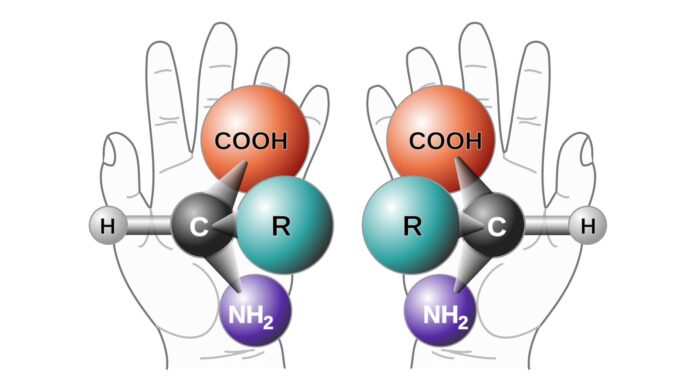

Look at your hands. They are mirror images of each other, yet a left glove will never fit your right hand. Many molecules work the same way, and life uses only one of the two versions. The Chemistry Nobel Prize 2026, awarded on October 7 to Henri B. Kagan and Kenso Soai, recognises the experiments that showed how such one-handedness can arise on its own. The official citation honours them “for the discovery of non-linear effects and autocatalysis in asymmetric organic synthesis.”
Kagan, born in 1930, is professor emeritus at what was Université Paris-Sud in France. Soai, born in 1950, is professor emeritus at Tokyo University of Science. They share 12 million Swedish kronor.
Molecules with a left and a right hand
Many molecules come in two forms built from the same atoms, joined in the same order, but arranged as mirror images. Chemists call this chirality, from the Greek word for hand. The two forms often behave differently in the body. Carvone is a simple example: one form smells of spearmint, the other of caraway.
Life is strictly one-handed. The amino acids in your proteins are all “left-handed,” and the sugars in DNA are all “right-handed.” Chemists call this homochirality. Yet when chemists make these molecules in a flask from non-chiral ingredients, they get an even 50-50 mix. How life ended up with only one version has been an open question since Louis Pasteur noticed in 1857 that bacteria would ferment one mirror form of tartaric acid and ignore the other.
The question is not only academic. Drugs, flavours, scents and crop chemicals often work only in one form, and the other can be useless or harmful. The Nobel committee’s popular science background points to thalidomide, the 1950s sedative behind thousands of birth defects, as the case that showed the industry how much the mirror form matters. (Thalidomide’s two forms also convert into each other inside the body, so making a pure version would not by itself have prevented the harm.)
A recipe written in 1953
In 1953, Charles Frank, a theoretical physicist at the University of Bristol, proposed how one hand could win. His model needed three ingredients: a chiral catalyst that favours one form; some effect that boosts the favoured form and holds back the other; and a reaction that produces more of its own catalyst, so that a small lead grows exponentially. This last property is called autocatalysis.
The first condition had been met in the early 1900s, when German chemist Willy Marckwald ran the first reaction that made slightly more of one form than the other. The other two remained a textbook puzzle for decades.
Kagan: when mixed pairs sit idle
In the early 1980s, chemists assumed that a catalyst made of, say, 75% left and 25% right molecules would produce a product with the same 75-25 split. Kagan doubted it. A metal-based catalyst grabs more than one chiral molecule at a time, so he reasoned that mixed left-right pairs might behave differently from matched pairs.
In 1986 he published three reactions showing he was right: the product’s imbalance could be far larger, or smaller, than the catalyst’s. The relationship was “non-linear.” That ticked off Frank’s second condition, and it became a practical tool. Today, chemists use non-linear effects to work out how a reaction runs and to get purer products.
Soai: the reaction that copies itself
Soai went after the third condition. After searching through many candidates, he found a molecule, a 5-pyrimidyl alkanol, that acts as a catalyst for its own production. In a 1995 paper, he started with a 2% excess of one form and ended with 87%. That met all of Frank’s conditions but still fell short of life’s 100%.
He kept going. In 2003, Soai reported a reaction that started from a mixture with no chiral ingredients at all. By chance, slightly more of one form appeared, and that tiny lead took over. In one run shown by the Nobel committee, an excess of just 0.00005% grew to more than 99.5% after three rounds. When Soai repeated the experiment, sometimes the left form won and sometimes the right, depending on what happened in the first moments. Heiner Linke, chair of the Nobel Committee for Chemistry, called the reactions “spectacular.”
Has the origin of life been explained?
No, and the committee does not claim it has. The Soai reaction is an artificial system, not the chemistry of early Earth, and nobody has shown that amino acids or sugars became one-handed this way. Labs around the world are now trying to build similar self-reinforcing reactions with the molecules life actually uses.
What the prize does establish is that Frank’s idea works in a real flask: a random tiny imbalance can grow into near-total dominance without any outside push.
It was one of three science prizes in a week that rewarded patient, decades-long work, alongside the medicine prize for optogenetics and the physics prize for the IceCube neutrino observatory.
Our take
The most striking detail in this prize is the coin toss. In Soai’s reaction, which hand wins is decided by chance, and then the result looks inevitable. That is a useful way to think about life’s one-handedness: it may not need a special cause, only a small accident and chemistry that amplifies it. The prize also shows the value of slow science. Frank posed the puzzle in 1953, Kagan’s key paper came 33 years later, Soai’s decisive result 50 years later, and the recognition 73 years later. None of that would have survived a funding system that expects results within a grant cycle.