


OpenAI says its models have done three things that would each make a career in their fields: disproved a central conjecture of computer science, settled a cluster of famous problems in harmonic analysis, and proved that the quantum theory of quarks and gluons exists in four dimensions. The claims, announced on October 26, have not been checked yet. What is new this time is how OpenAI is handling them: it has handed the work to some of the leading experts in each field and agreed not to call it proven until they say so.
The three claims
According to Interesting Engineering, which summarised OpenAI’s announcement, the first claim is a disproof of the Exponential Time Hypothesis (ETH). ETH says that a basic class of logic puzzles, Boolean satisfiability problems, cannot be solved dramatically faster than by brute force. It is used as an assumption in hundreds of papers on graph theory, databases, computational biology and geometry, which prove that a problem is hard by showing that a fast algorithm would contradict ETH. If ETH is false, many of those hardness results lose their footing, although, as the report notes, a disproof would not automatically give faster algorithms for real problems.
The second is a proof of the local smoothing conjecture, posed by Christopher Sogge in 1991, in every dimension. It concerns how waves concentrate and roughly says that extreme focusing cannot last. OpenAI says the result also settles the Kakeya conjecture, about how small a set can be while containing a line segment in every direction, and Stein’s restriction conjecture. Larry Guth, Hong Wang and Ruixiang Zhang proved local smoothing in two dimensions in 2019, and Wang and Joshua Zahl proved the three-dimensional Kakeya conjecture in 2025.
The third is in physics: existence proofs for interacting quantum field theories with gauge fields and fermions in four dimensions, including quantum chromodynamics (QCD), the theory of the strong force. The work also touches pure Yang-Mills theory, part of one of the Clay Mathematics Institute’s seven Millennium Prize problems.
Who is checking
The computer science claim will be reviewed by Russell Impagliazzo and Ramamohan Paturi of UC San Diego, who formulated ETH in the first place, and Ryan Williams of MIT. The physics will be handled by a group led by Nobel laureate David Gross, with Michael Douglas, Arthur Jaffe, Igor Klebanov and Nikita Nekrasov, which plans to write its own account before releasing the model’s material. OpenAI has agreed to fund a conference on the ETH claim and has pledged $5 million to the Simons Foundation for workshops examining the work.
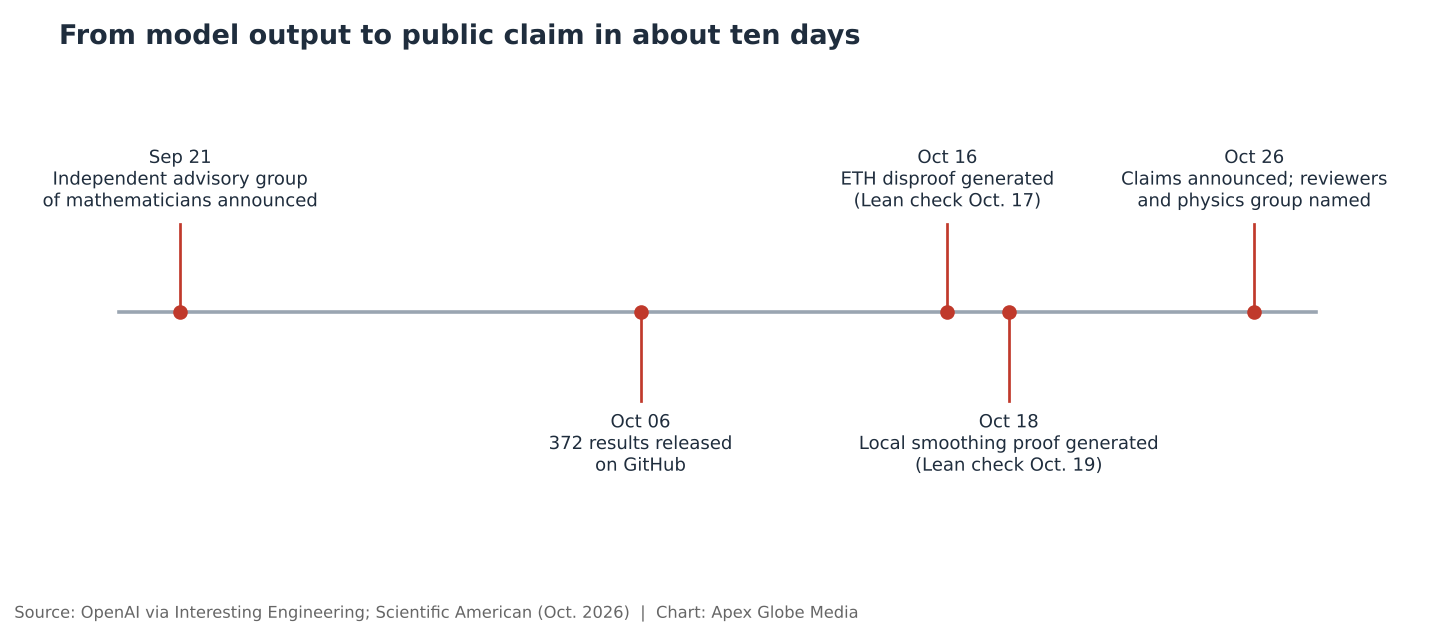
Both mathematical proofs were also checked in Lean, a programming language in which every logical step of a proof is verified by computer. The ETH disproof was generated on October 16 and formalised the next day; the local smoothing proof was generated on October 18 and formalised on October 19.
Why mathematicians are still cautious
A Lean check is strong evidence that a proof is logically correct, but it only proves what was written down. If the formal statement of the theorem differs subtly from what mathematicians mean by the conjecture, a perfect proof can still answer the wrong question. That is why human review matters even after machine verification.
There is also history. Earlier this month OpenAI released 372 results at once, and Scientific American reported that mathematicians expect it to take months to tell whether they contain new ideas or mostly recombine known techniques. MIT’s Andrew Sutherland said claims should be treated as unverified until the model is released and the results can be replicated. An advisory group of mathematicians that OpenAI itself set up in September recommended releasing the model, the exact prompts and compute time for each result; OpenAI has so far published only average compute times and no prompts. We covered that earlier batch in our roundup of a busy AI week.
Still, the choice of reviewers is notable. Asking the authors of ETH to judge its disproof, and asking a group led by a Nobel laureate to write up the physics in their own words, is close to the most credible process available short of journal peer review.
Our take
If even one of these claims holds, it will change how science is done, because it would mean AI systems can now produce results that the best human experts spent decades failing to find. But “OpenAI says” is not “mathematicians agree,” and the gap between the two is exactly what the next few months are for. The sensible position is interest without belief: the review panels are strong, the Lean checks are a good sign, and the claims deserve to be taken seriously and verified, not celebrated in advance.