


Google has run an AI model on its own chips in orbit for the first time. The prototype satellite of Project Suncatcher, Google’s research effort to build data centers in space, is online and has answered its first prompt from the ground: a haiku about being in space, written by Google DeepMind’s Gemma 4 model on a Tensor Processing Unit (TPU) circling the Earth. It is a tiny job, but it is the first real test of whether the chips that power Google’s AI can survive and work in space.
What the satellite did
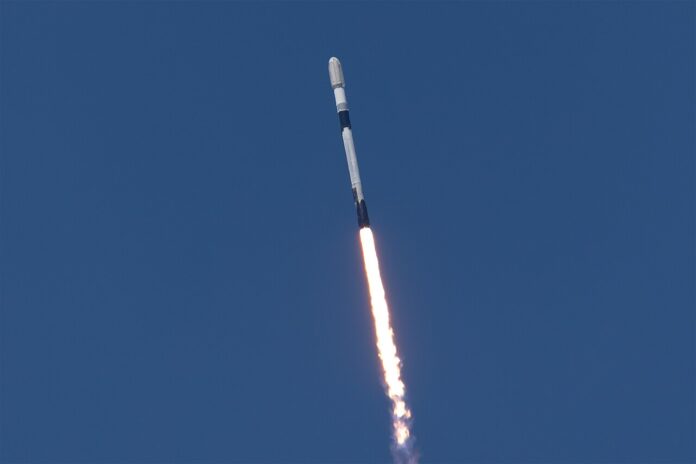
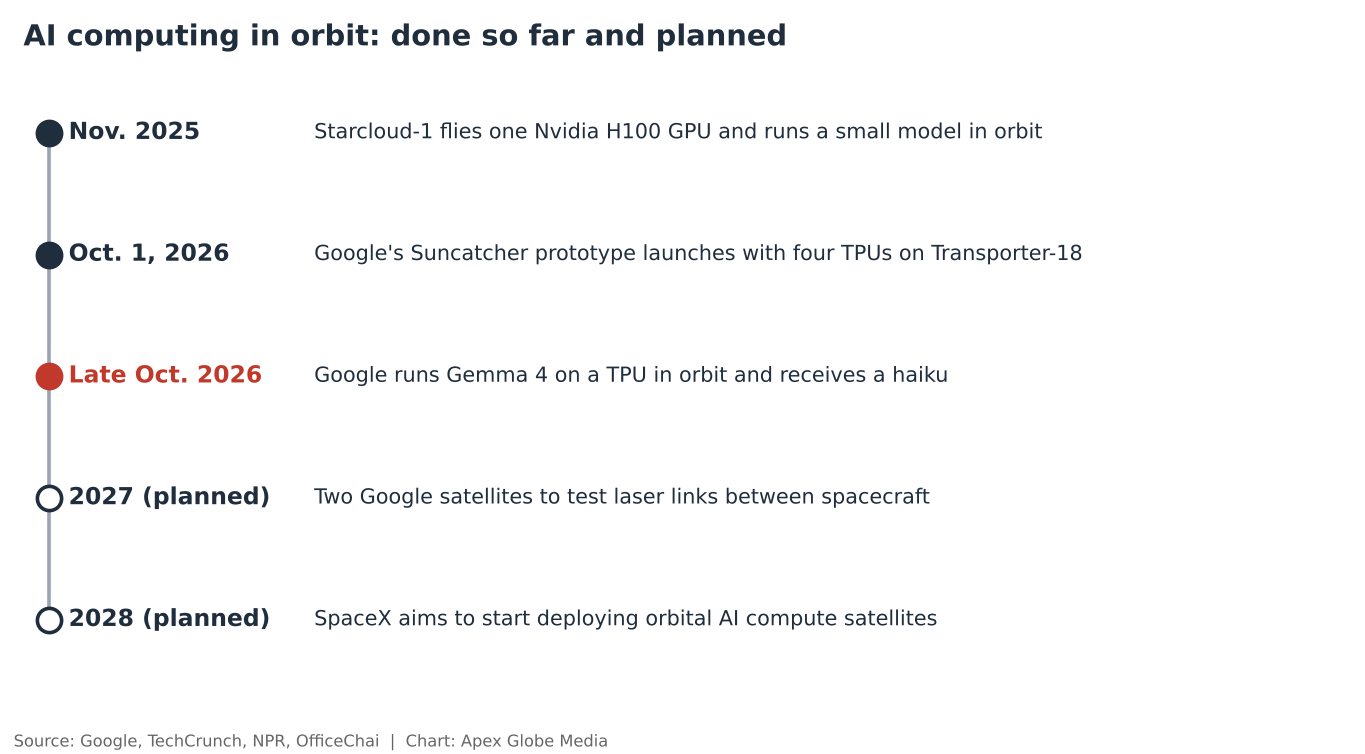
The satellite, built with the satellite imaging company Planet, launched on October 1 on SpaceX’s Transporter-18 rideshare mission from Vandenberg Space Force Base in California, alongside more than 100 other spacecraft. After about three weeks of checks, engineers sent their first prompt this week, TechCrunch reported on October 30. Google chief executive Sundar Pichai called it a “‘hello world’ milestone for Project Suncatcher”: the team “sent a command up to orbit, booted up the TPU, ran the prompt, and received our first complete response back on earth.”
The response came down as the satellite passed over a ground station in Svalbard, Norway, OfficeChai reported. The team then tested space-themed limericks and asked the satellite to report on conditions around it. A Google spokesperson said the spacecraft is “operating nominally.”
The hardware is modest. The fridge-sized satellite carries four TPUs and generates up to 1 kilowatt of electricity, but the chips’ power demand means it can run only one of them, for about 20 minutes at a time. Unlike the satellites Google plans later, this prototype is in a standard orbit and relies on batteries rather than near-constant sunlight, NPR noted.
What Google wants to learn
The real purpose is to see how AI chips cope with space. According to Google, the coming weeks will gather data on how the TPUs handle “the physical stress of spaceflight and the radiation and thermal extremes of space.” Radiation can flip bits in memory and silently corrupt data. Google’s ground tests in particle accelerators suggested this matters little when a model is answering questions but more when it is being trained, and the satellite will now show whether that holds in orbit.
Heat is the other big problem. On Earth, data centers cool chips with air and water; in a vacuum, heat can only be radiated away. Project lead Travis Beals told NPR that the radiators are among the heaviest parts of the satellite, and weight is what makes launches expensive. If this test goes well, Google plans to launch two more satellites in 2027 to test laser links between spacecraft, the key to making many satellites work together like one data center.
Why put data centers in space at all
The argument is energy. AI is driving a rush for electricity on Earth, from federal loans to squeeze more power from nuclear plants to local fights over new data centers. In the right orbit, solar panels get sunlight almost constantly, with no land, water or neighbours to worry about. “This project is about tapping into the best way to use solar power to run AI compute,” Beals told NPR.
Google is not alone. The startup Starcloud flew an Nvidia H100 chip in orbit in November 2025, and SpaceX says it expects to start deploying orbital AI compute satellites as early as 2028. The two big players are closely linked: Alphabet owns a significant stake in SpaceX, and both companies’ plans depend on SpaceX’s Starship becoming fully and rapidly reusable to bring launch costs down. SpaceX is already deep in the AI business on the ground too, leasing $40 billion of Nvidia chips this month.
Even Google is cautious about timing. “I don’t see this being something where it’s cheaper to do this in the next five years,” Beals told NPR, adding that space and ground data centers will coexist for a long time. Carnegie Mellon professor Brandon Lucia warned that repairs, cooling and communications in orbit could be 10 to 100 times more costly and complex than on the ground.
Our take
A haiku from orbit is a publicity-friendly milestone, but the important result will come later, from months of radiation and temperature data on chips that were designed for air-conditioned buildings. Space data centers make sense on paper because Earth’s grids and communities are pushing back against AI’s power hunger. Whether they make sense in practice depends on launch prices that do not yet exist and on engineering problems that a single 20-minute chip session cannot solve. Suncatcher is a worthwhile experiment, not a solution to AI’s energy problem, and it should be judged that way.