

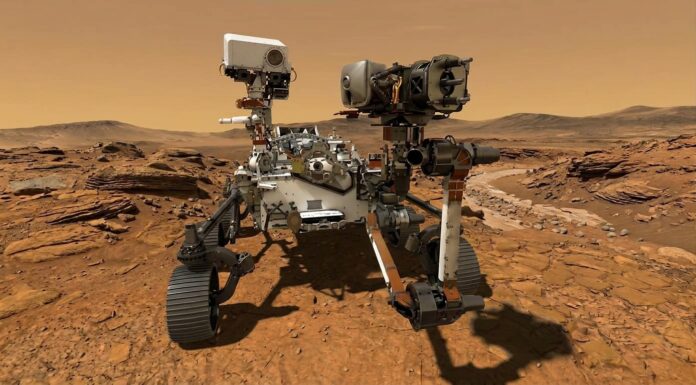

NASA’s Perseverance rover has driven farther than any vehicle on another world. On October 11, on its 2,006th Martian day, its odometer reached 28.10 miles (45.22 kilometers), passing the 28.06 miles (45.16 kilometers) that Opportunity logged between 2004 and 2018, NASA said. The margin is only about 60 meters. The time it took is the real story: Opportunity needed almost 15 years, Perseverance about five and a half.
Same speed, different brain
Perseverance is not a faster machine. Guinness World Records, which now lists it for the greatest distance travelled on another world, notes that it has the same top speed as Opportunity and a drivetrain similar to Curiosity’s. What changed is how much of the driving the rover does by itself.
Radio signals take several minutes to travel between Earth and Mars, so nobody can steer a rover in real time. Planners on Earth pick waypoints, and the rover has to work out the route between them. Perseverance does this with AutoNav, which photographs the ground while moving, builds a 3D map of hazards and plans a path around them. It runs on a separate computer, the Vision Compute Element, so the rover can think and drive at the same time instead of stopping to plan.
NASA’s numbers show how big that shift is. Perseverance has driven more than 90% of its distance on AutoNav. Opportunity and its twin Spirit used the first Martian version of the system for only about 5% of theirs. Sojourner, the first Mars rover in 1997, judged the ground ahead using 20 measurement points; Perseverance processes 600,000 every time it looks. It can now cover up to about 412 meters in a single day’s drive.
Upgrades made on Mars
The rover keeps getting better after landing. “Perseverance is a better driver than the one that landed, and we’re not done,” said Mark Maimone, deputy team chief for robotic operations. The latest software teaches it to steer less and roll more, and to check its position against orbital maps in the middle of a drive.
That position check relies on a piece of reuse. According to Guinness, hardware first used to talk to the Ingenuity helicopter, which ended its mission in 2024, was repurposed in February for “Mars Global Localisation,” which pins down the rover’s location to within about 25 centimeters. The next problem engineers want to solve is sun glare in the navigation cameras, which Maimone called “the next frontier.”
A record that changed hands slowly
The off-world distance record has moved only a few times. The Soviet Lunokhod 2 rover drove about 39 kilometers on the Moon in 1973, by NASA’s count, a record that stood for four decades until Opportunity passed it in 2014. The longest drive by astronauts, on Apollo 17 in 1972, was 35.7 kilometers. Curiosity, still working in Gale Crater, has logged more than 38 kilometers.
The original Perseverance mission called for no more than 12.4 miles (20 kilometers) of driving. “We have blown well past that,” said project manager Steven Lee. Guinness reports that the rover’s motors, rated for 20 kilometers, are now expected to last at least 100. NASA has extended the mission through roughly the end of 2028.
Where it is going
When it set the record, the rover was crossing a region called Lac de Charmes on the western rim of Jezero Crater, heading toward an area named Idubi, where the science team hopes to find traces of ancient hydrothermal systems. After that it will head south to Rainbow Falls, a 100-meter block of old crust pushed up by the impact that formed the crater. Perseverance has collected 29 rock and soil samples so far.
Driving more means reaching more of those targets. Each kilometer the rover can cover safely on its own adds rocks and layers of ancient sediment within reach of its instruments, without adding hours of planning on Earth.
Our take
The record is a software achievement, not a hardware one. Perseverance has the same wheels and top speed as its predecessors, yet covered the same ground in about a third of the time because it was given a dedicated computer for navigation and kept receiving better code after landing. For future missions, that is a cheaper lesson than building faster rovers: invest in onboard autonomy and plan to keep improving it for years. It also matters beyond Mars, since the same need to act safely without constant human input applies to probes heading to places where signals take hours, not minutes.